
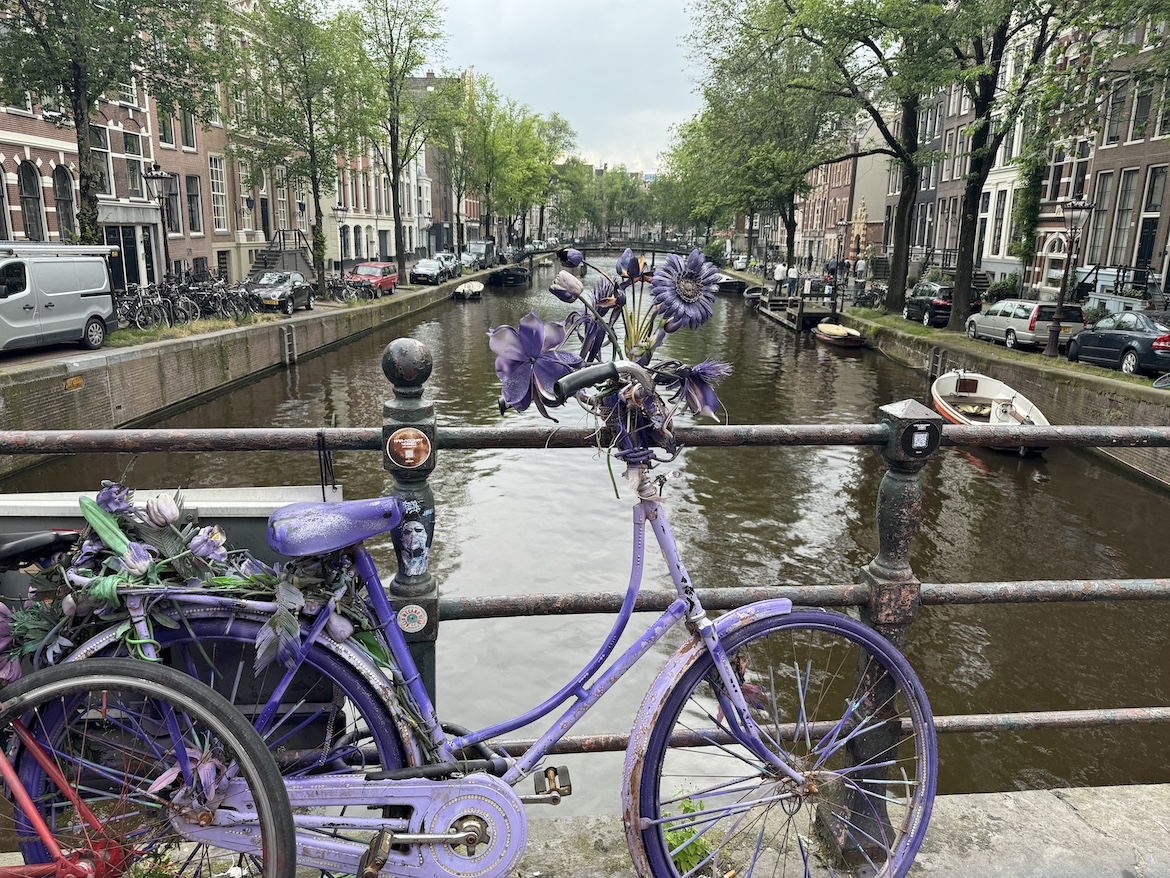

The real voyage of discovery consists not in seeking new landscapes, but in having new eyes.
This post is part of my 33 Days in Europe series. Visit the hub page to follow along, see the full itinerary, and sign up for email updates.
When planning our 33-day trip through Europe, visiting the Anne Frank House became my red pillow, a quirky term I invented for the one idea that anchors the beginning of a plan. Planning an adventure, a trip, or even a day out with girlfriends can feel overwhelming when there are too many destinations or activities to choose from. Finding that one thing gives everything else a place to grow, eventually becoming a complete itinerary.
NOTE: Because visiting the Anne Frank House was only one part of Day 18, I couldn’t include all of the history and context behind this remarkable place. I’ve gathered that information, along with my recommended books, documentaries, graphic memoirs, and other resources, on a companion page. For the full experience, I hope you’ll continue reading there.
The Anne Frank House
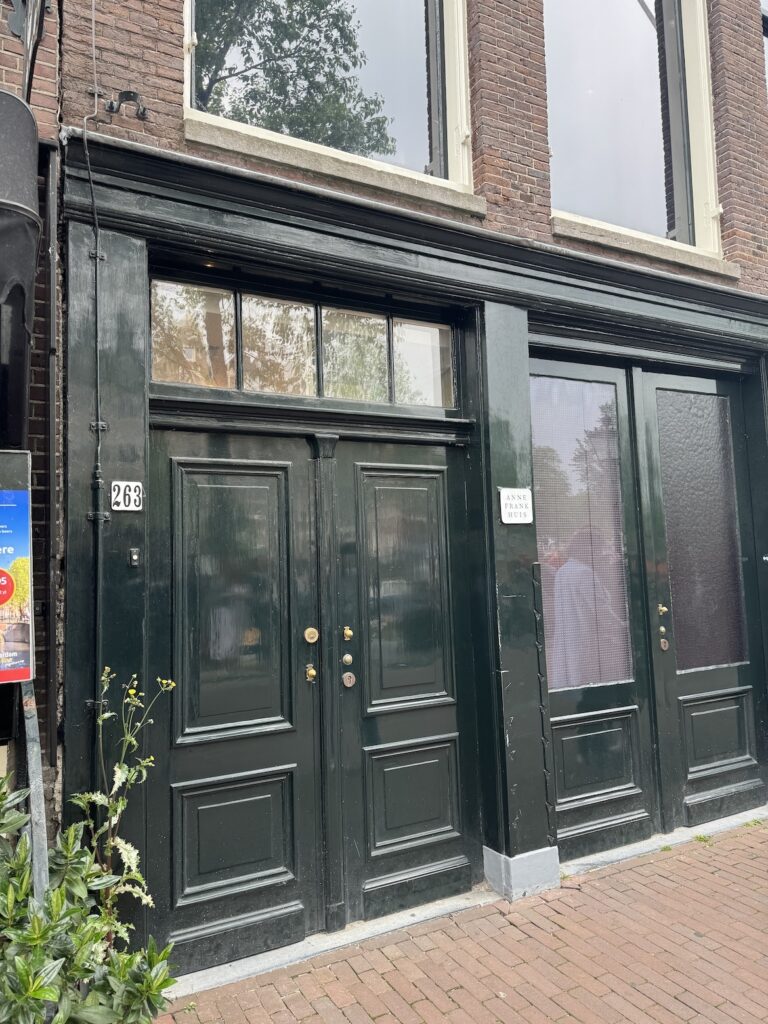
The entrance to the Anne Frank House at Prinsengracht 263 in Amsterdam.
Choosing just one place I wanted to visit proved simple: the Anne Frank House. I’ve long wanted to understand where Anne Frank hid from the Germans during World War II. Not just read about the secret annex. I wanted to stand in it, hear the boards creak, envelop it with all my senses.
If she could live it, I could bear witness.
I prepared well. I thought I knew what to expect.
The Secret Annex
I struggle to find the words to illustrate how I felt walking through the bookshelf passage and into the secret annex. It just felt, in a word: otherworldly.
The bookshelf looks ordinary against the wall, but it opens inward like a door and reveals a staircase that takes you to the secret annex, the hiding place of Anne Frank and seven other people. This is where they hid from the Nazis during WWII.
Standing there brought back a contradiction I’ve pondered for years: How could so many people — eight of them — live in such a small space for so long, over a couple of years, without being discovered? And yet, I’ve also pondered the question: how could they live in such a large space and go undetected by society? They lived directly above an office and a production facility full of working people. The group couldn’t flush a toilet or run water or make any noise at all during the day, for fear of the workers hearing them and investigating.
Walking the old wooden stairs, I tried not to make them squeak. Perhaps it was an instinct to shield my presence, as Anne and the others would have, and that made me feel a bit silly. Still, I tried to imagine what it would have been like to climb in silence, like they did, knowing that a single sound could expose them to a horrible fate.
We visitors, all strangers to one another, walked single file in unison, slowly through the rooms. No one that I could see stood tall. We slouched a bit and lowered our heads slightly in humble tribute, as if we were attending a funeral. The fact that we all did this with nary a notion to do so sends a surge of faith in humanity through me. Only looking back did I realize this happened; so subtle did it occur.
Every now and then a creak from an old floorboard or a wet sniffle would break the silence like sharp, staccato notes.
I felt a bit of pressure moving with the line because I wanted to stay. I wanted to stare. I wanted to think. And I did. I stepped back out of line for as long as I could bear. The line flowed around me until, finally, I slipped back into it. I rationalized that I had a right to do that having paid my money and reserved my time.
Perhaps my angst stemmed from feeling like an intruder in her personal space. Shame twined itself around my desire to be there.
Was I a gawker?
So many emotions pricked at me.
Standing there, safe and sound, in that space, amid the swirl of it all, I was struck by how much of life comes down to chance.
Me now, her then.
And what would Anne have done with her precious life had she been allowed to live?
Anne’s Bedroom
Stepping into her bedroom startled me: it was empty.
I felt deflated, and then felt bad for feeling deflated. This wasn’t a real estate showing.
I learned later in the tour that Otto Frank, Anne’s father, kept the space exactly as it was after the Germans came in and cleared everything out. He opted not to refurnish it, not to try to make it seem more pleasant or to depict what was actually there. He felt it important to keep it real.
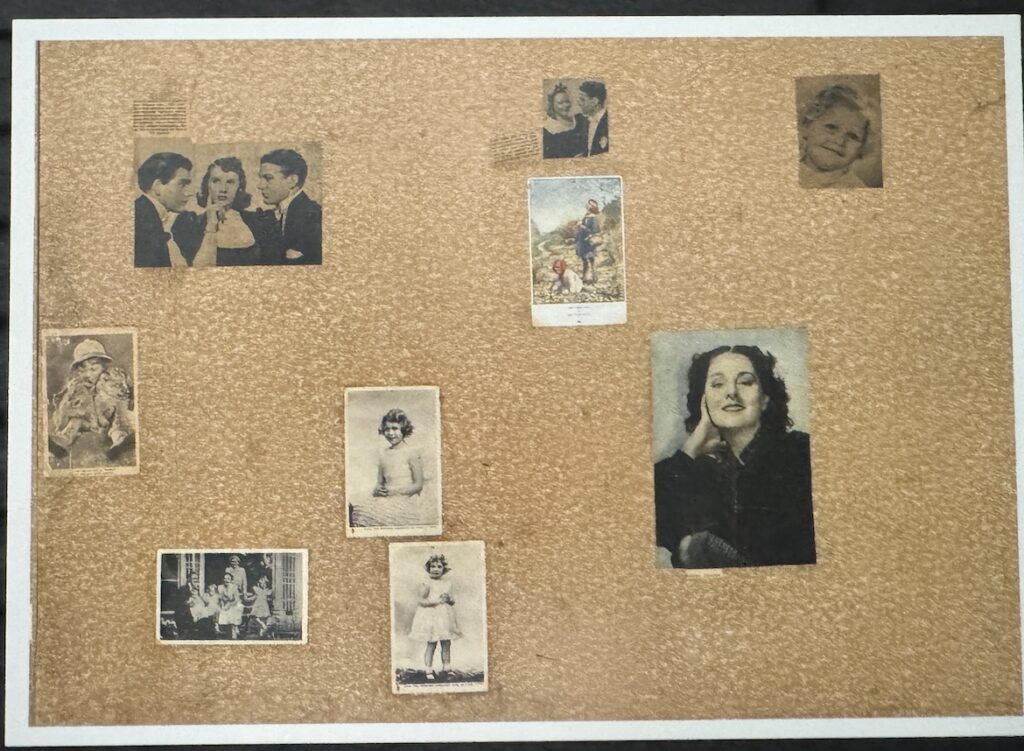
Being in that room with a line of other people before me and behind me, it still felt empty. Beside where I imagined her bed once stood, a sheet of plexiglass now protects the photographs and postcards she pinned to the wall—or at least what remains of them.
That wall has become famous, but only a fraction of Anne’s original collection remains in place. Her collection included movie stars, postcards, landscapes, young children, and illustrations cut from magazines. She continually rearranged and added to them during her two years in hiding. Over the decades there was water damage, fading, visitors touching the walls, and even souvenir hunters removing pieces before the museum installed protective glass. The conservators deliberately did not replace missing pictures, so what is left today is the authentic surviving wall, gaps and all.
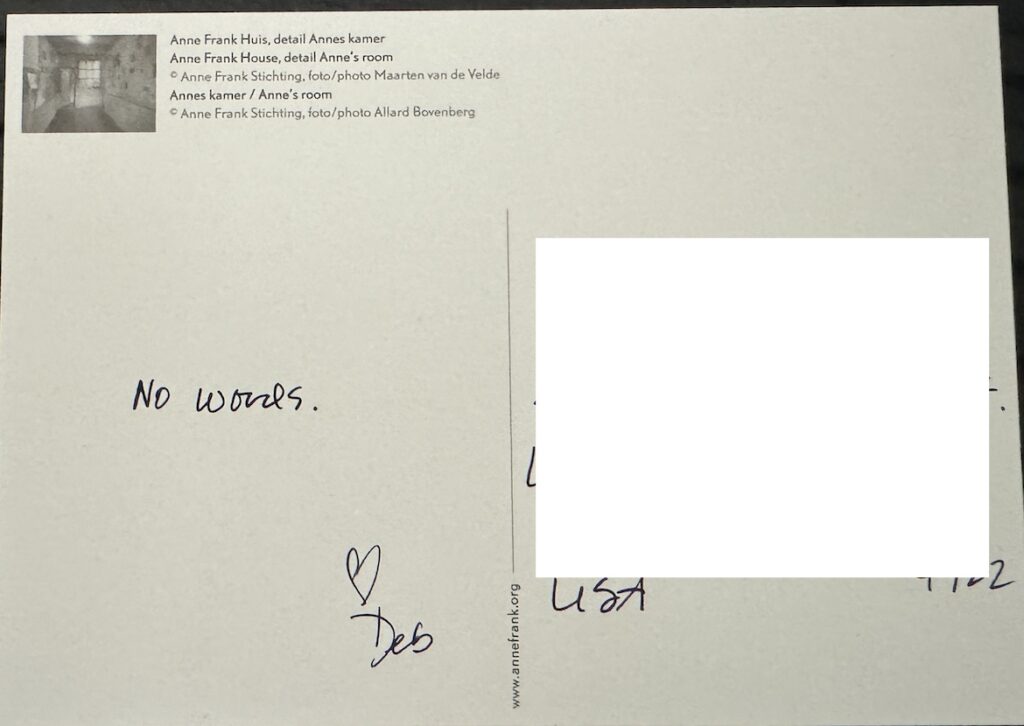
Photography is not allowed inside the building. Below is a photo of the front and back of a postcard I sent to a friend. The photo on the postcard shows Anne’s bedroom wall where she pinned her collection.
-

- A museum postcard showing the photographs and magazine pictures Anne Frank pasted on her bedroom wall in the Secret Annex.
-

- After touring the Anne Frank House, I mailed this postcard to a dear friend who is an author. I couldn’t find the words to describe what I had experienced, so I wrote only two: No words.
Moving On
After visiting her bedroom, I went up to the attic where Anne looked out at the chestnut tree she wrote about so movingly in her diary. And of course, we toured the kitchen, the bathroom—all of it. The lower level houses a museum with large black-and-white photographs of the people in hiding and their helpers, along with brief information about each of them. I was thankful I had prepared before my visit to understand their story and the fate of everyone involved. The museum simply can’t provide enough context for every visitor to fully grasp what happened. Having that knowledge beforehand made the experience infinitely more meaningful. (I hope you’ll also read my companion page. I think you’ll find it enriches this post as well.)
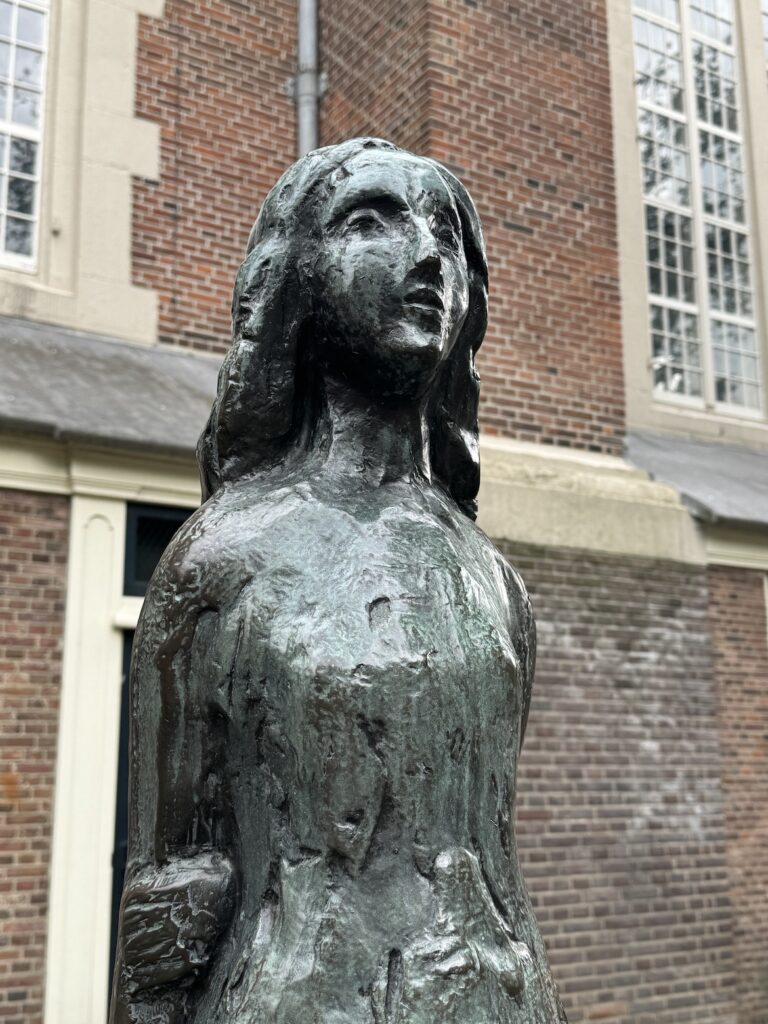
The bronze Anne Frank statue stands beside the Westerkerk, just a short walk from the Anne Frank House. Created by Dutch sculptor Mari Andriessen, it was unveiled in 1977 to honor Anne’s life and enduring legacy.
Anne’s red-checkered diary is there, safe in a glass case.
When it was time to leave, I didn’t want to. I felt… heavy.
So Ron and I went to the museum’s coffee shop and sat in silence over a cappuccino. I didn’t want to go out into the happy world. I wanted to hang on to what I was feeling, give my experience time to settle in me, and continue to pay my respects.
Finally stepping outside, the cool breeze whipped up from the canal and washed over me, transporting me back to reality. And I felt thankful. Thankful for all the good in my life. Thankful for my life.
Yet I wanted to shout to the world: Why?
Final Thoughts
While in hiding, Anne and the others listened to an illegal radio, following the Allies’ advance and believing freedom was drawing nearer. They were betrayed before it arrived.
Standing there was real. She was real. I am real.
I’m caught between the worlds of then and now. It’s easy to look at black-and-white photographs and imagine Anne Frank’s story as something distant, almost belonging to another world. But it didn’t happen in another world. It happened in an ordinary building that still stands along a canal in Amsterdam. And when you stand there, I promise you, you feel that in a way no photograph can convey.
Anne was all of us.
Any of us.
She was an ordinary young girl in a sea of humanity, living her life the way we all do, until the world decided otherwise.
It could have been me.
And it could have been you.
And that means it could happen again.
OUT & ABOUT
Naming Houses
The name D’Fuyk uses an old Dutch spelling of de fuik, meaning a fish trap or funnel-shaped net.
A fuik is designed so fish can swim in easily but struggle to find their way back out, thanks to its narrowing, funnel-like shape.
Before street numbers became common, many houses and warehouses in Amsterdam were known by names instead. Those names often reflected a trade, symbol, profession, or something associated with the building or its owner.
This 17th-century canal house (below), known as D’Fuyk, is part of that tradition. Whether it referred to fishing, shipping, or something else entirely has been lost to time, but the name remains as a reminder of Amsterdam’s maritime heritage.
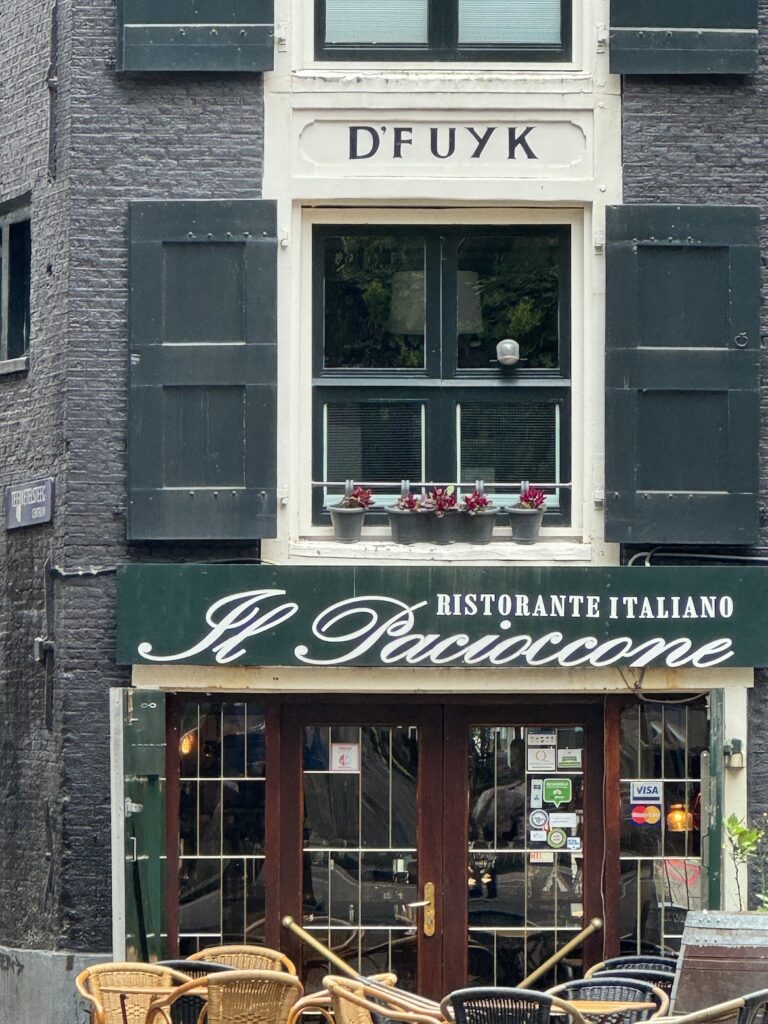
Before street numbers became common, many Amsterdam houses and warehouses were known by names instead. This 17th-century building bears the name D’Fuyk, derived from the old Dutch word de fuik, meaning a fish trap.
City of Bikes
Decorated bicycles are everywhere in Amsterdam. Some belong to businesses, cafés, flower shops, or boutiques, where they catch the eye and add personality to a storefront. Others are public art or personal creative projects, adding another layer of color and whimsy to the city.
I just love this bright blue bicycle outside this tattoo and piercing boutique. If they were trying to get my attention, it worked.
And yes, Amsterdam’s canals really do have a bicycle problem. Every year, crews remove between 12,000 and 15,000 bicycles from the city’s waterways. Most are believed to end up there because of theft, vandalism, accidents, or simply being knocked into the canal. Specialized barges equipped with cranes regularly fish them out, making “bike fishing” just another uniquely Amsterdam job.
Fortunately, this one appears destined for a much happier fate: making us smile.
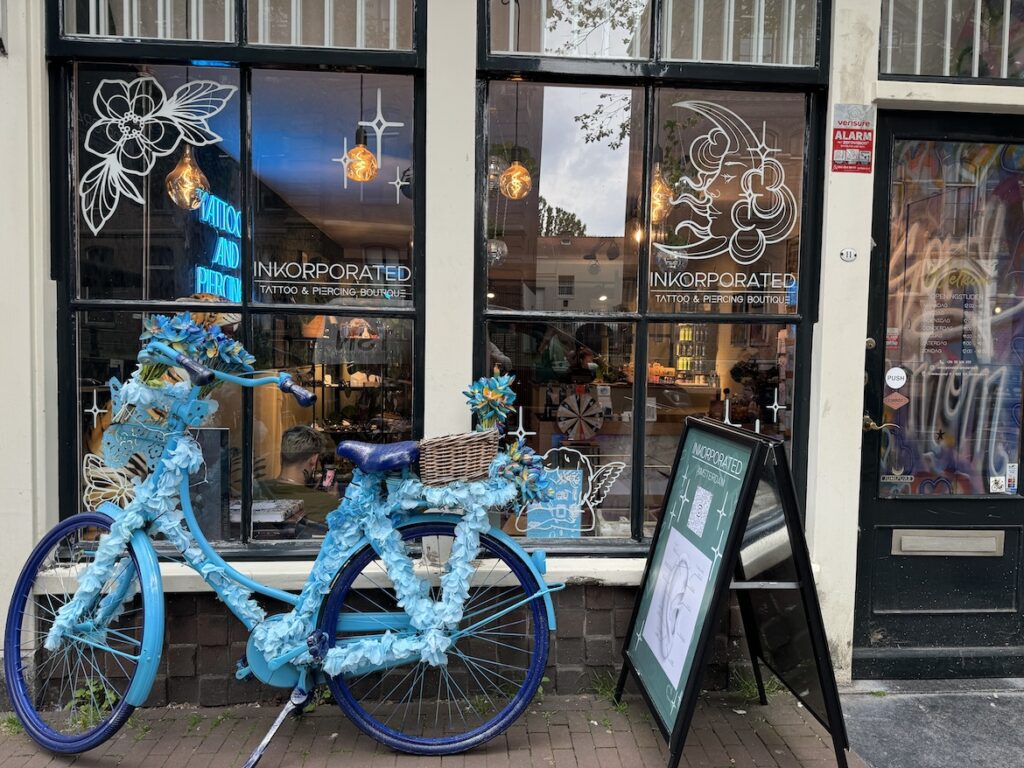
Businesses throughout Amsterdam often decorate bicycles as eye-catching storefront displays. This bright blue floral bicycle was impossible to walk past without smiling.
Why are the houses in Amsterdam so tall and thin?
The answer is actually quite simple.
During the Dutch Golden Age, taxes and the cost of canal-front property were based largely on the width of a building’s façade facing the street or canal. To reduce those costs, many homeowners built narrow houses that stretched upward instead.
As a result, Amsterdam became known for its tall, slender canal houses, often with steep staircases and several floors. Because furniture couldn’t easily be carried up those tight stairways, many homes were built with a beam and hook projecting from the roof. Large items were hoisted through the windows instead.
Today, those narrow façades are one of Amsterdam’s most recognizable architectural features. What began as a practical response to taxes and limited space has become one of the city’s defining charms.
To me, they’re quintessentially Amsterdam, and I’ve come to love them.
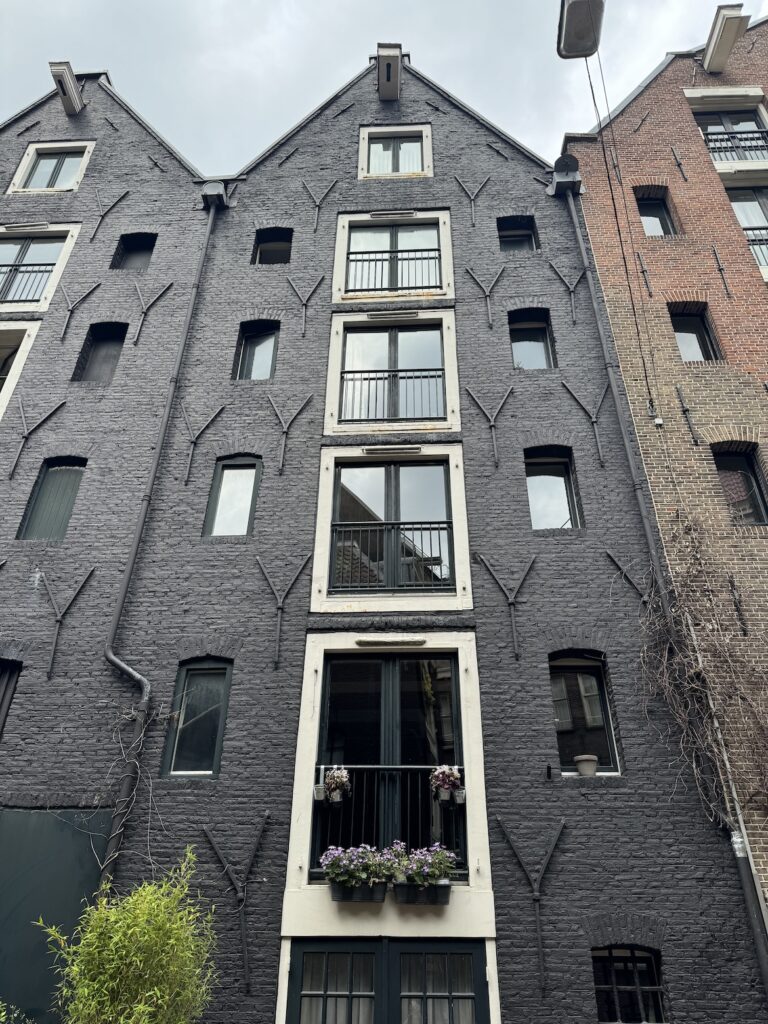
Standing at street level, it’s easy to appreciate just how tall Amsterdam’s narrow canal houses really are. Building upward allowed owners to maximize living space while minimizing taxes.
Beurspassage
The Beurspassage (below) is a beautiful pedestrian passageway connecting Damrak and Nieuwendijk in central Amsterdam, near Dam Square. Opened in 2016, it was part of a major redevelopment project in the area around Amsterdam Central Station.
The artwork overhead is called Amsterdam Oersoep, or Amsterdam Primordial Soup, created by artists Arno Coenen and Iris Roskam. Covered in millions of glass mosaic tiles, it depicts a fantastical world inspired by Amsterdam’s relationship with water, marine life, evolution, and its history as a trading and seafaring power.
A mythical sea creature glides across the ceiling, surrounded by imagery that blends nature, science, mythology, and imagination. Just so lovely. Standing directly beneath it, I completely missed it at first.
The installation serves as a reminder that Amsterdam’s story has always been intertwined with water—from the marshy landscape on which the city was built to the waterways that helped make it a global trading power.
What struck me most was the juxtaposition. Just steps from centuries-old canals and historic buildings, this contemporary work feels both unexpected and perfectly at home. The Beurspassage is a reminder that Amsterdam isn’t frozen in time. The city continues to evolve, embracing new ideas while honoring its past.
Perhaps that’s why this place resonates with me. It reflects one of the mottos I live by: Life is Change. Surrounded by history, this modern installation feels hopeful—a reminder that Amsterdam continues to reinvent itself without losing the character that makes it unmistakably Amsterdam.
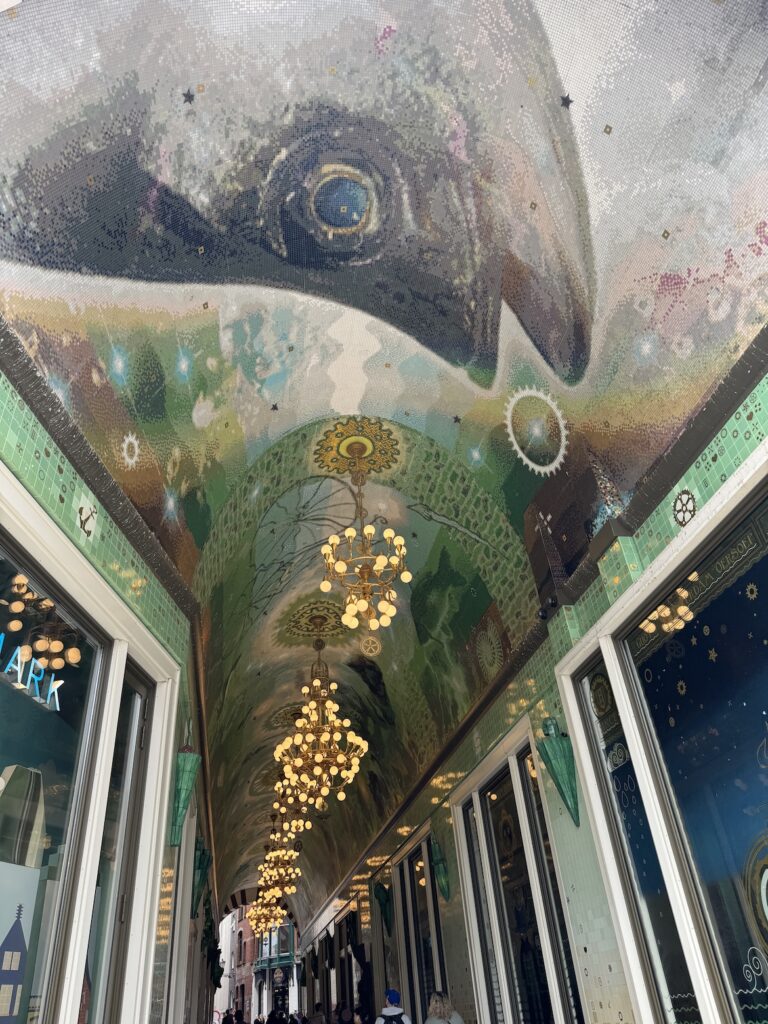
The ceiling of the Beurspassage is covered in Amsterdam Oersoep (Amsterdam Primordial Soup), a shimmering mosaic by artists Arno Coenen and Iris Roskam. Millions of glass tiles transform this pedestrian passage into one of Amsterdam’s most unexpected works of public art.
TK Maxx
At first glance, TK Maxx looks like a European knockoff of TJ Maxx. The logo is nearly identical, the stores feel familiar, and yet one letter is different.
It turns out they’re the same company.
When TJ Maxx expanded into the United Kingdom in the 1990s, there was already an established British retailer called T.J. Hughes. To avoid confusion, the company adopted the name TK Maxx instead. The rebranding stuck and was eventually used throughout much of Europe.
TJ Maxx → United States
TK Maxx → United Kingdom, Ireland, Germany, Poland, Austria, the Netherlands, and other European markets
The stores operate the same way, offering designer and brand-name merchandise at discounted prices with constantly changing inventory.
In other words, it’s the same treasure-hunt shopping experience under a slightly different name.
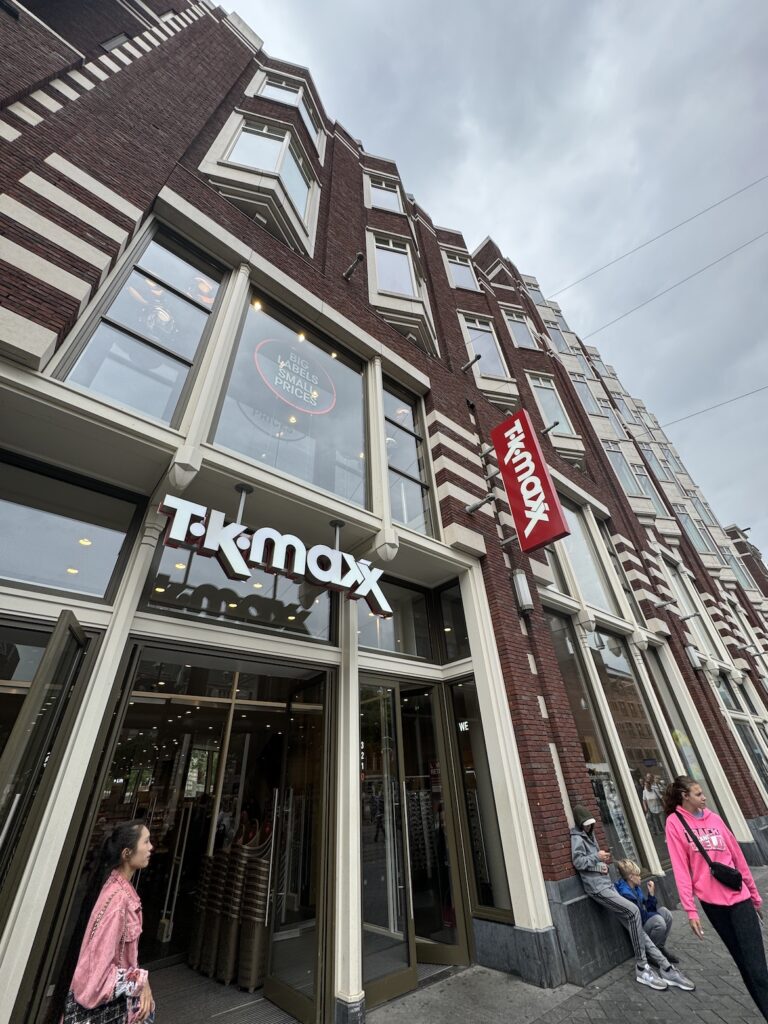
The logo looks almost identical to TJ Maxx, but in Europe the stores are called TK Maxx. The name changed to avoid confusion with the British retailer T.J. Hughes, but it’s the same company and the same treasure-hunt shopping experience.
Graffitti
I’ve always liked graffiti. At its best, it feels like a form of public expression—creative, rebellious, and sometimes surprisingly beautiful.
If you’re wondering whether all this graffiti means I wandered into a rough part of town, the answer is no. Amsterdam is consistently ranked as one of Europe’s safer major cities, and graffiti is found throughout the city, even in desirable central neighborhoods. Much of it consists of tags rather than elaborate murals, especially on utility boxes, loading doors, and service entrances like this one.
Graffiti without permission is generally illegal, and I certainly understand the frustration of property owners who have to clean or repaint their buildings. At the same time, Amsterdam embraces street art through commissioned murals and designated spaces where artists are encouraged to create.
Walking through Amsterdam though, I appreciated both sides. Some pieces felt like visual clutter. Others evoked rebellion and the spirit of a city that never stops evolving.
Like so much in Amsterdam, it isn’t entirely one thing or the other.
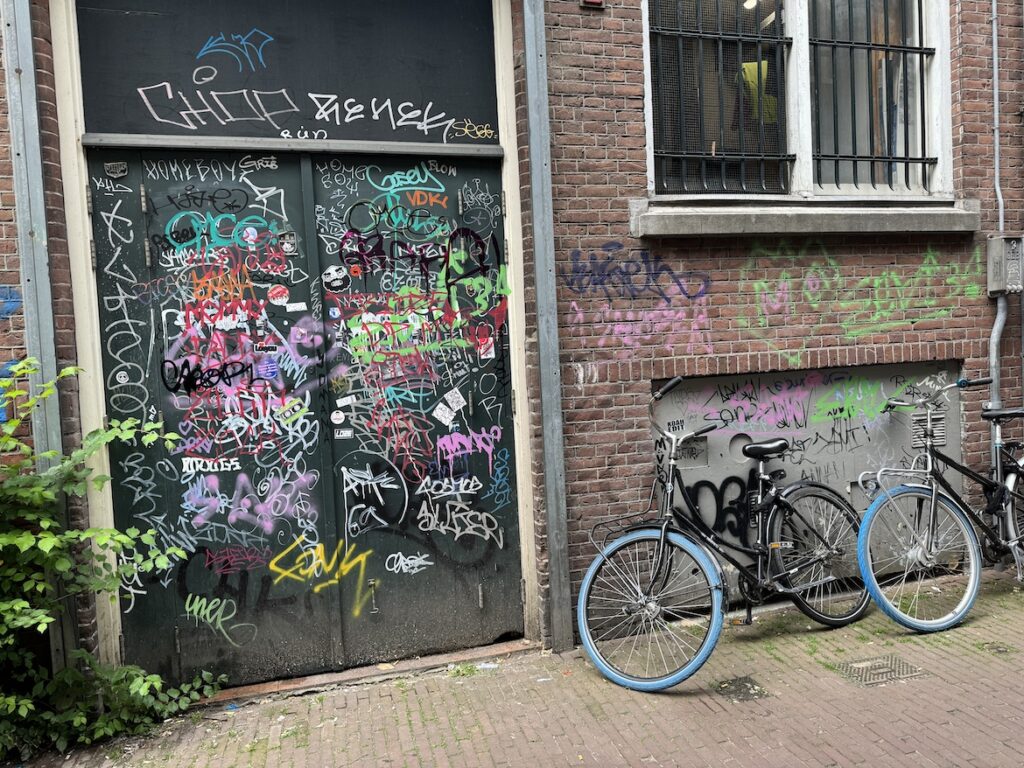
A colorful wall of graffiti and a parked bicycle capture another side of Amsterdam—one that blends everyday life with layers of street art and creative expression.
Urban Beauty
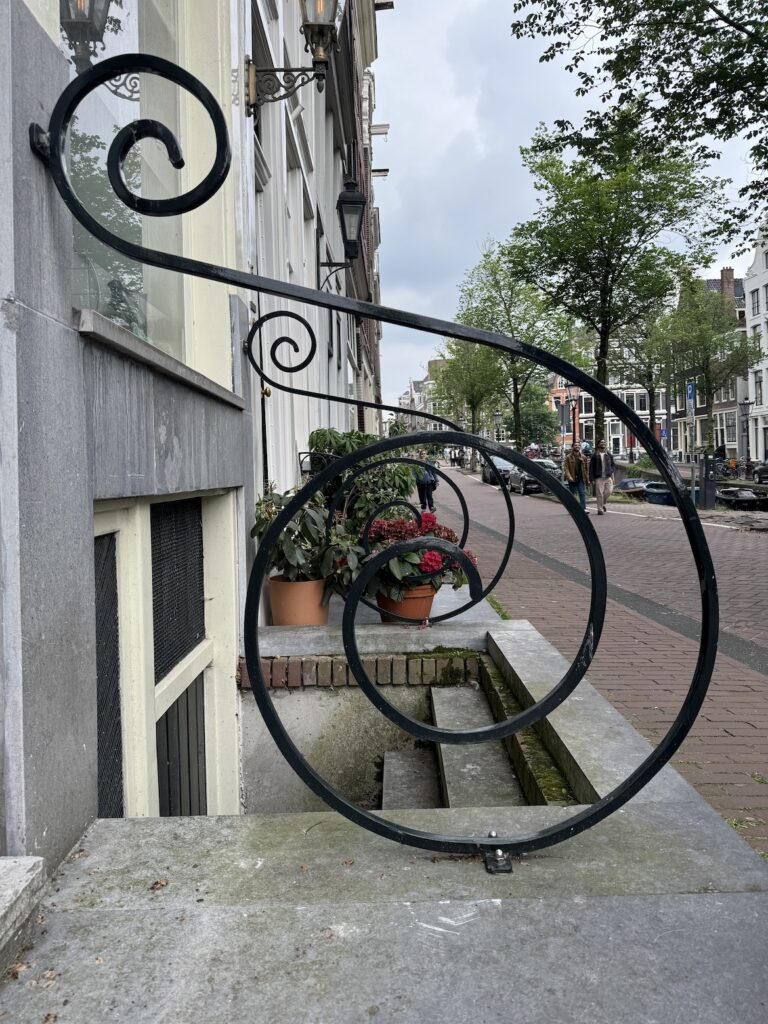
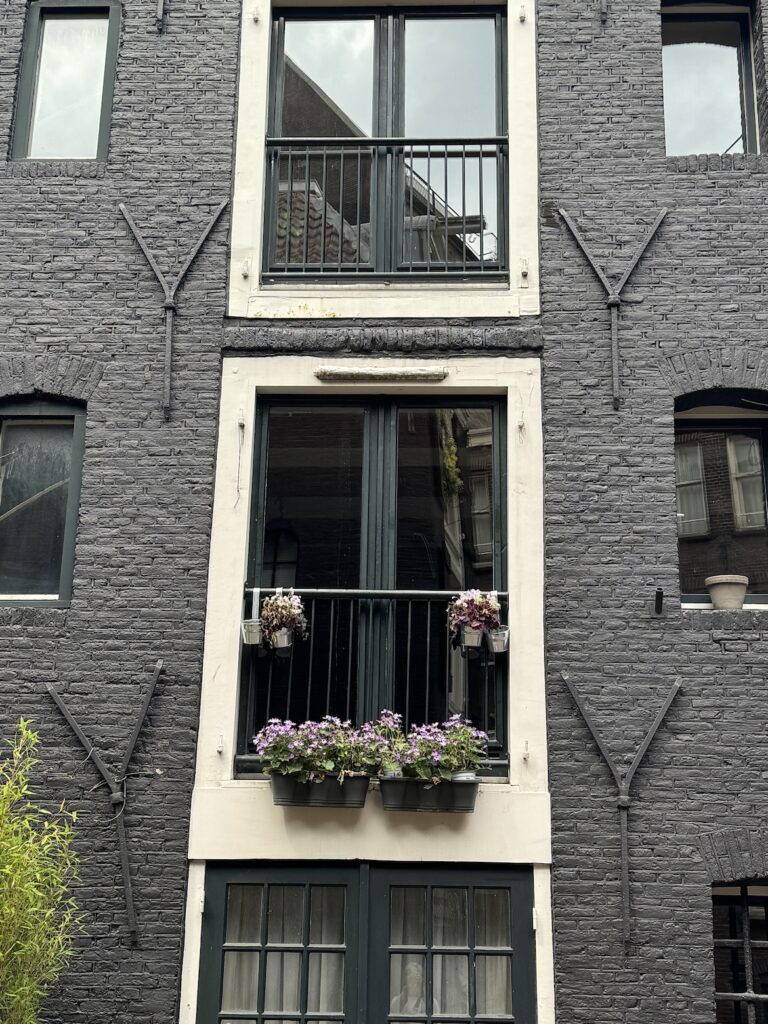
One of the greatest pleasures of wandering Amsterdam wasn’t checking famous landmarks off a list. It was slowing down enough to notice the details. A flower box beneath a window. A decorative iron railing curling into graceful spirals. Brickwork that has weathered centuries.
None of these things appears on a must-see list, yet together they create the character of the city.
Their ordinary is my extraordinary.
-

- Just a decorative stair railing. There are so many details to behold in Amsterdam.
-
- Their ordinary is my extraordinary. I never tired of looking up and noticing the everyday details that make Amsterdam, Amsterdam.
Flowers: Amsterdam’s Signature
By the end of the day, it felt only fitting that flowers would have the final word.
The Netherlands has been synonymous with flowers for centuries. Tulips may be the country’s most famous bloom, but I found flowers everywhere—spilling from window boxes (well, it’s Europe after all), decorating bicycles, brightening bridges, and transforming ordinary street corners into stunning urban art.
That final display, complete with a toilet nestled among the blossoms, seemed to capture Amsterdam perfectly. Beautiful. Creative. A little quirky. Entirely unafraid to surprise you.
It was the perfect way to end a day spent discovering that Amsterdam is so much more than canals and bicycles.
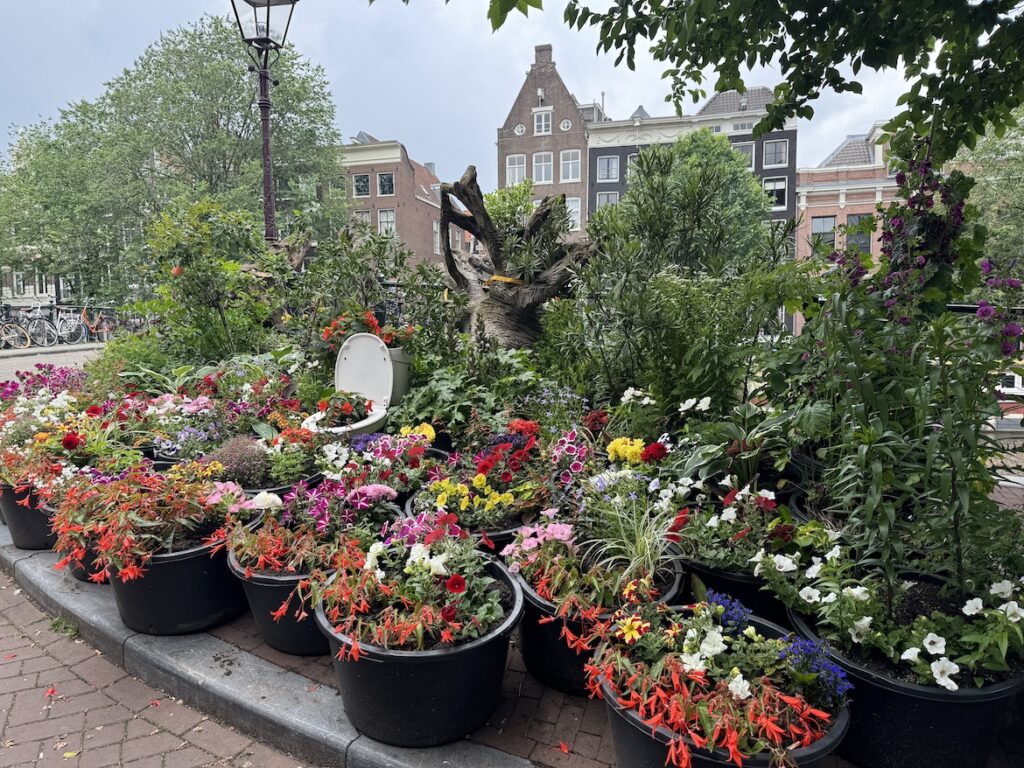
One thing I’ve learned about Amsterdam: never assume you’ve seen it all. Around the next corner might be a riot of flowers… and a toilet planted in the middle of them. I never did learn the story behind it, but somehow it felt perfectly at home.
That’s a Wrap
This has been a very long post about a very long day. We began with an emotional visit to the Anne Frank House, then wandered Amsterdam with no agenda beyond noticing what caught our eye.
It was, in every sense, a perfect day in Amsterdam.
That’s a wrap for Day 18 of our 33 Days in Europe series.
Missed a day or just joining in? The full 33 Days in Europe series is right here.
Next Up – Day 19 of my 33 Days of Europe series:
- Day 19 – Bruges Bound: Trains, Chocolate, and Hotel Rose Red
Gear I Recommend
See all my travel gear and essentials here: Things I Love & Recommend
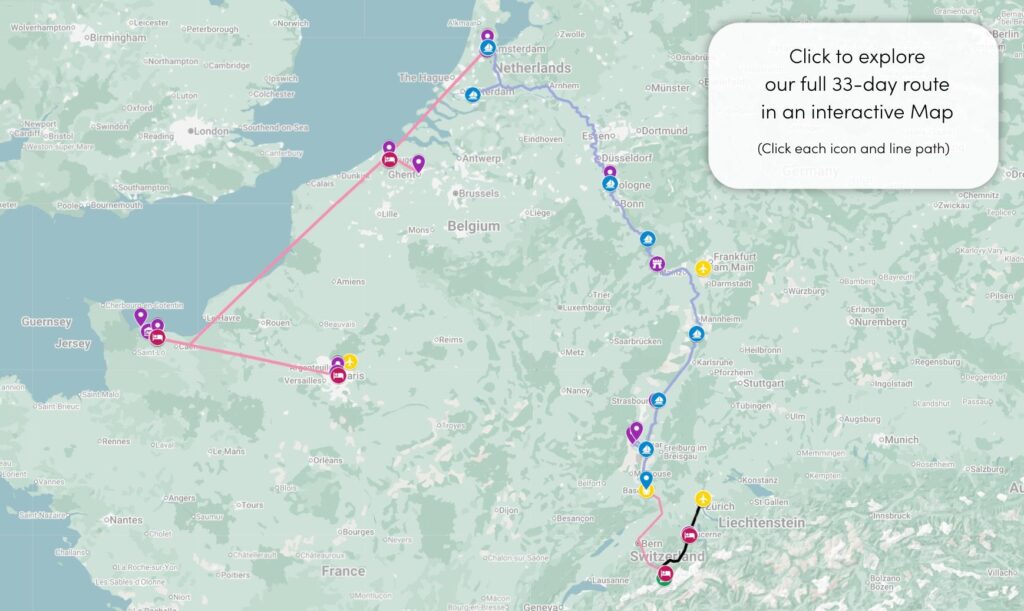
Detailed Map of the Entire Journey
Below is a visual summary of our full 33-day route—hotels, attractions, Viking cruise path and stops, as well as transit modes and paths—hiking, train, plane, gondola.
Click to explore the interactive version and wander through the journey pin by pin.
In case you missed these…
Day 15 – First Day in Amsterdam: Canals, Cappuccinos, & Laundry