
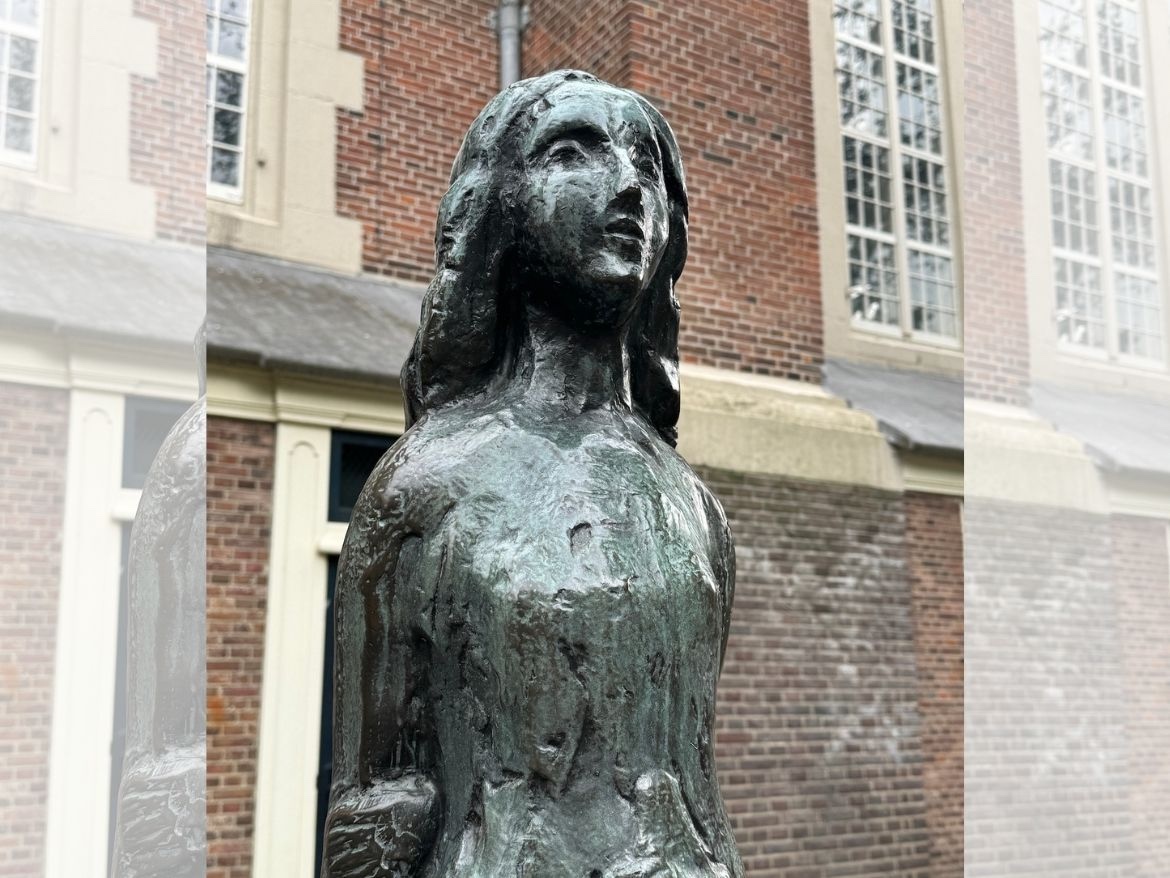
For the dead and the living, we must bear witness.
Why This Page Exists
For years, I immersed myself in memoirs, graphic novels, films, television series, and firsthand accounts related to Anne Frank, the Holocaust, and World War II. What began as curiosity became something deeper: an attempt to better understand one of history’s darkest chapters and the people who lived through it.
Eventually, that curiosity led me across the Atlantic.
When planning our 33-day trip through Europe, Anne Frank House became my red pillow — the small idea that sparked an entire journey. If you’re unfamiliar with the concept, a red pillow is what I call the seed of an adventure, the thing that gives shape to a trip when the world feels too large and there are too many destinations to choose from.
For me, that place was Anne Frank House in Amsterdam.
I wanted to stand where Anne Frank stood. I wanted to see the Secret Annex for myself. Not because I believed I could truly understand what happened there, but because I felt a responsibility to bear witness as best I could.
If she could live it, I could bear witness.
Along the way, I accumulated questions. Some were answered. Others remain unanswered. This page brings together the answers I found, along with the books, films, television series, and resources that helped me better understand Anne’s story.
If you haven’t yet, read about how it actually felt to be in the Anne Frank House in my Day 18 – Anne Frank House & the Heart of Amsterdam: A Perfect Day
Who was Anne Frank?
Anne Frank (pronounced Ann-uh, not Ann, as I later learned) was a 13-year-old Jewish girl whose diary became one of the most widely read accounts of the Holocaust. After Nazi Germany occupied the Netherlands during World War II, Anne, her parents, her older sister, and four other Jewish people went into hiding inside a concealed section of her father’s business building in Amsterdam. For more than two years, they lived in what is now known as the Secret Annex, relying on trusted helpers for food, supplies, and news from the outside world.
While in hiding, Anne wrote honestly about fear, hope, family life, growing up, and her dreams for the future. In August 1944, the group was discovered and arrested. Anne later died of typhus in the Bergen-Belsen concentration camp at the age of 15, only weeks before the camp was liberated. Her father, Otto Frank, was the only member of the eight people in hiding to survive the Holocaust. After the war, he published Anne’s diary, introducing millions of readers to her voice and ensuring that her story would never be forgotten.
Anne Frank’s story is just one of more than six million Jewish men, women, and children murdered during the Holocaust. Millions of lives were cut short. Millions of stories were never written, preserved, or heard.
Anne’s story endures not because her suffering was greater than anyone else’s, but because her voice survived. Through her diary, we meet a bright, thoughtful 13-year-old girl who wrote about friendship, family, dreams, and the future while living under constant fear of discovery. She endured hunger, increasing shortages, confinement, air raids, and the daily terror that a single knock on the door could mean the end.
Yet even amid those unimaginable circumstances, Anne never completely surrendered her belief in humanity. Her hope was not naïve. It existed alongside fear, frustration, loneliness, and despair. Perhaps that is why her words continue to move readers today. They remind us that even in history’s darkest moments, the human spirit can still search for goodness.
In spite of everything, I still believe that people are really good at heart.
Questions I Had About Anne Frank and the Holocaust
Who were the people who lived in hiding in the Annex?
The Eight People Who Lived in the Secret Annex
July 1942 – August 4, 1944
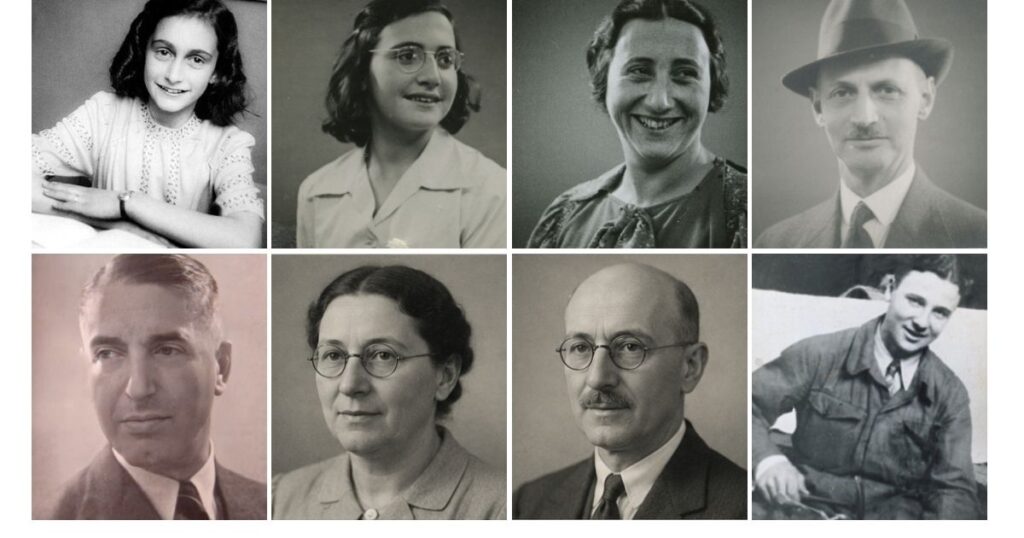
From left to right:
- Anne Frank — A Jewish teenager whose famous diary has helped millions of people understand what it was like to live in hiding during the Holocaust.
- Margot Frank — Anne’s older sister.
- Edith Frank — Anne’s mother.
- Otto Frank — Anne’s father and the only one of the eight occupants to survive the Holocaust.
- Fritz Pfeffer — A German-Jewish dentist who joined the group in the Secret Annex in November 1942.
- Auguste van Pels — Wife of Hermann van Pels and mother of Peter van Pels.
- Hermann van Pels — Business associate of Otto Frank and father of Peter van Pels.
- Peter van Pels — Son of Hermann and Auguste van Pels.
Image Credits
Anne Frank, Margot Frank, Edith Frank, Otto Frank, Peter van Pels, and Fritz Pfeffer:
Public domain, via Wikimedia Commons.
Auguste van Pels and Hermann van Pels:
AI-generated recreations based on historical reference photographs because I was unable to locate copyright-free historical portraits suitable for publication.
Fritz Pfeffer note:
The Wikimedia Commons version of Fritz Pfeffer’s portrait has been digitally upscaled using AI software (Remini.ai Photo Enhancer). According to Wikimedia Commons, this process may have introduced inaccurate or speculative details that were not present in the original photograph.
What is the Secret Annex?
The term “Secret Annex” comes from the Dutch title Het Achterhuis, which literally means “the back house.”
In her diary, Anne Frank referred to the hiding place as Het Achterhuis because it was located in the rear annex of her father’s business building, hidden behind the main offices.
When the diary was first translated into English, the title became The Diary of a Young Girl, and translators adopted “The Secret Annex” as the English name for the hiding place. “Annex” accurately describes an addition or secondary part of a building, while “secret” emphasizes that its existence had to remain hidden.
Today, “Secret Annex” is the standard English term used by historians, museums, publishers, and the Anne Frank House itself.
The hiding place was:
• Hidden behind a movable bookcase.
• Located at the rear of the warehouse and office building.
• Positioned above and behind the business run by Otto Frank.
• Kept out of sight from employees and visitors, although a small group of trusted helpers knew it existed.
You can purchase tickets to visit Anne Frank House and the Secret Annex here.
How long did Anne Frank and the others live in the Secret Annex?
The eight occupants of the Secret Annex lived in hiding for just over two years, from July 6, 1942, until August 4, 1944.
Who helped them?
Several people risked their lives to help the eight occupants of the Secret Annex.
Miep Gies, a secretary who worked for Otto Frank’s company, became one of the most important helpers. Along with her husband, Jan Gies, she helped obtain food, supplies, ration coupons, books, and news from the outside world. She visited the Annex regularly and developed close relationships with those in hiding.
Victor Kugler and Johannes Kleiman were Otto Frank’s business associates. They helped manage practical matters and supported the hiding operation behind the scenes.
Bep Voskuijl, one of the younger office workers, often brought books, supplies, and companionship to Anne and the others. Her father, Johannes Voskuijl, helped build the movable bookcase that concealed the entrance to the Secret Annex.
All of them understood that discovery could lead to arrest, imprisonment, deportation, or death.
Who was Miep Gies?
Of all the people connected to Anne Frank’s story, Miep Gies is the one who fascinates me most.
Born in Austria, she came to the Netherlands as a child and later worked as a secretary for Otto Frank. When the Frank family went into hiding, Miep became one of the people responsible for helping them survive.
For more than two years, she brought food, supplies, books, and news while knowing that discovery could cost her freedom or even her life.
After the arrest, she preserved Anne’s diary and papers without reading them.
When Otto Frank returned after the war, Miep gave the writings to him. He later arranged for publication, making Anne’s words available to the world.
Miep consistently rejected being called a hero. She insisted she had simply done what any decent person should do.
I find that response almost as remarkable as her actions.
Miep lived to the age of 100 and spent much of her later life speaking about Anne Frank, the Holocaust, and the importance of standing up for others.
People should never think that you have to be a very special person to help those who need you.
What happened to the eight occupants?
On August 4, 1944, the Secret Annex was discovered, and all eight occupants were arrested by the Gestapo. They were first taken to a prison in Amsterdam, then to the Westerbork transit camp, and later deported to Auschwitz. From there, some were transferred to other camps as the war drew to a close.
Only Otto Frank survived.
Edith Frank died at Auschwitz in January 1945.
Margot Frank and Anne Frank were transferred to Bergen-Belsen, where both died of typhus just weeks before the camp was liberated.
Hermann van Pels was murdered in Auschwitz in late 1944.
Auguste van Pels was transferred through several camps before dying in Germany in the spring of 1945. The exact circumstances and date of her death remain uncertain.
Peter van Pels survived Auschwitz but was later forced on a death march to Mauthausen concentration camp, where he died just days before liberation.
Fritz Pfeffer died of illness in Neuengamme concentration camp in December 1944.
Otto Frank returned to Amsterdam after the war, where Miep Gies gave him Anne’s diary—the pages she had gathered and safeguarded after the arrest. Reading it was the first time Otto truly came to know many of Anne’s private thoughts and dreams. He fulfilled her dream of becoming a writer by ensuring her diary was published, allowing her voice to reach millions around the world.
What happened to the helpers after the arrest?
When the Secret Annex was raided on August 4, 1944, several of the helpers were also arrested.
Victor Kugler and Johannes Kleiman were taken into custody. Kleiman was eventually released because of poor health. Kugler was sent to a labor camp but later escaped during the chaos near the end of the war.
Miep Gies and Bep Voskuijl were not deported. After the arrest, Miep entered the Annex and gathered Anne’s diary, notebooks, and loose manuscript pages, hoping to return them to Anne after the war.
Instead, she eventually gave them to Otto Frank, the only member of the Annex to survive.
Without Miep Gies, Anne’s voice might have been lost forever.
How were the Annex occupants able to follow the war?
The occupants secretly listened to a forbidden radio and followed developments in the war closely. Through broadcasts from London, they learned about Allied advances and major military events.
As the war progressed, they became increasingly hopeful that liberation was near.
Who betrayed them?
The truthful answer is that no one knows.
Despite decades of investigation, no one has conclusively identified who alerted the German authorities.
How close were they to freedom before taken away?
Painfully close.
The Allied invasion of Normandy had already taken place, and Anne frequently wrote about military developments and hopes for liberation.
Anne and Margot Frank died of typhus at Bergen-Belsen concentration camp in early 1945. The camp was liberated only weeks later.
Why is the Secret Annex empty to this day?
After the arrest, the Nazis removed the furniture and possessions.
Following the war, Otto Frank chose not to refurnish the rooms. He wanted visitors to experience the emptiness left behind rather than view a reconstruction.
One exception remains: Anne’s bedroom wall, covered with the photographs and postcards she collected. Despite fading from moisture and time—and despite some items being taken by visitors in the years after the war—it has been preserved.
Resources I Recommend
The resources below helped me understand different aspects of Anne Frank’s story, the Holocaust, World War II, and the extraordinary choices ordinary people made under Nazi occupation.
Anne Frank
The Diary of a Young Girl by Anne Frank
The obvious place to begin. The Diary of a Young Girl is more than a historical document; it is the voice of a bright, observant teenager trying to make sense of confinement, fear, family dynamics, and a rapidly changing world. Her diary has been translated into more than 75 languages.
Which Edition of The Diary of a Young Girl Should You Buy?
You’ll find dozens of editions of Anne Frank’s diary, and it can be surprisingly confusing to know which one to choose. Some editions are abridged, adapted for younger readers, or based on earlier versions of the diary that omitted passages Anne wrote.
I recommend purchasing The Diary of a Young Girl: The Definitive Edition. It restores entries that were left out of earlier publications, giving readers the most complete version of Anne’s diary available for general audiences. If you’re reading Anne Frank for the first time—or returning to her words years later—this is the edition I believe is worth owning.
Anne Frank’s Diary | The Graphic Adaptation, illustrated by David Polonsky. The Graphic Adaptation is a wonderful companion or entry point, especially for younger readers or anyone who wants the story to land in a different way.
But as an adult, I cherish this version. It’s brilliant.
The Anne Frank House
If you’re planning a trip to Amsterdam—or simply want to learn more—the Anne Frank House is an essential resource. The museum’s website shares the history of the Secret Annex, Anne’s story, educational materials, and practical information for planning a visit.
If you hope to visit in person, be aware that tickets are sold under strict guidelines. They can only be purchased online through the official Anne Frank House website and are released six weeks in advance. Because demand is extremely high, popular dates and times often sell out quickly, so it’s worth planning ahead.
Graphic Survivor Memoirs
Maus I and Maus II by Art Spiegelman
Maus I and Maus II are the Pulitzer Prize-winning graphic memoir that tells the story of Spiegelman’s father, a Holocaust survivor, while also exploring how trauma reverberates across generations. Together, they are widely regarded as among the most important works ever written about the Holocaust. The box set is available here.
We Are on Our Own by Miriam Katin
We Are On Our Own is a graphic memoir about Katin and her mother surviving Nazi-occupied Hungary. Personal, intimate, and beautifully illustrated.
Survivor Memoirs & Companion Novels
Elie Wiesel’s Night Trilogy
Together, these three books trace the journey from surviving the Holocaust to living with its aftermath.
Night — What happened.
Dawn — What do we do after surviving?
Day — How do we live with what happened?
Night by Elie Wiesel
Night is a powerful memoir, first published in 1956 ,describing Wiesel’s experiences in Auschwitz and Buchenwald.
Dawn by Elie Wiesel
Dawn is a short novel and companion work to Night. Where Night bears witness to survival, Dawn turns toward the moral questions that come after: revenge, responsibility, and what survival asks of a person next.
Day by Elie Wiesel
Day is the final book in the trilogy. It explores survivor’s guilt, memory, and the lifelong emotional impact of the Holocaust as one man struggles to build a meaningful life after unimaginable trauma.
The Hiding Place by Corrie ten Boom
The Hiding Place is the memoir of a Dutch woman whose family hid Jews during the Nazi occupation. One of the most moving accounts I’ve read about resistance and courage.
Films & Television
The Hiding Place
The film adaptation of Corrie ten Boom’s memoir The Hiding Place, bringing her family’s story of hiding Jews during the Nazi occupation to the screen.
A Small Light
If I had to recommend one thing beyond the diary itself, it would be the television miniseries A Small Light. Rather than focusing primarily on Anne, it tells the story of Miep Gies and the helpers who risked their lives to protect those in hiding. It answered many of the questions I still had after reading the diary, and it’s the single best resource that helped me understand the day-to-day mechanics of survival — how they ate, how supplies moved, how two years actually passed inside that space, and more.
Band of Brothers
Band of Brothers was produced by Steven Spielberg and Tom Hanks, this award-winning television miniseries is based on the true story of Easy Company, an American Army parachute infantry unit that fought across Europe during World War II. Many of the surviving veterans served as consultants, sharing their firsthand experiences with the cast and filmmakers to help ensure an authentic portrayal. In my opinion, it’s one of the most realistic depictions ever made of what American soldiers experienced during the war and one of the most valuable World War II resources I’ve encountered. It also provides valuable context for the military campaign unfolding while Anne and the others were in hiding.
Factual notes: The series is based on historian Stephen E. Ambrose’s nonfiction book of the same name. Several Easy Company veterans were involved with the production, including Richard Winters, Donald Malarkey, Edward Heffron, and William Guarnere. Like any dramatization, some events are condensed, but the series is grounded in the real experiences of the men who lived it.
Schindler’s List
Schindler’s List is one of the most powerful films ever made about the Holocaust. The story is devastating, and John Williams’ score remains among the most haunting pieces of film music I’ve ever heard. Winner of seven Academy Awards, including Best Picture.
The Boy in the Striped Pajamas
The Boy in the Striped Pajamas is a film that explores the Holocaust through the eyes of a child. While fictional, it raises important questions about innocence, prejudice, and the consequences of hatred.
Nuremberg
Nuremberg is a miniseries that helped answer one of the questions that had long troubled me: how ordinary people became participants in extraordinary evil. If you’re interested, I’ve written more about it here.
Together, the diary, the graphic adaptation, A Small Light, Band of Brothers, and Corrie ten Boom’s memoir gave me the widest — and somehow still the most personal — view of the war I’ve found anywhere. Each one fills in a piece the others can’t: Anne’s interior world, the mechanics of hiding and helping, the military context unfolding outside, and the cost of choosing resistance.
Questions That Linger
The more I learn, the more questions emerge.
Would I have shared food when food was scarce?
Would I have risked my life to protect friends or co-workers, knowing the cost might be torture, or worse?
Could I have done what the helpers did?
I don’t know.
The more I learned about Anne Frank, the more interested I became in Miep Gies. Anne’s story is extraordinary. But Miep’s story asks a question that feels much closer to home: What would I do if helping someone put my own life at risk?
What I do know is that every book, film, memoir, and visit has deepened my understanding — not only of history, but of human behavior itself.
And that conversation continues.
This page will continue to grow.
As I discover additional books, documentaries, museums, and educational resources that deepen my understanding of Anne Frank and the Holocaust, I’ll add them here.