

Recently, something unexpected happened to me while watching Nuremberg (2025), a film about the 1946 Nuremberg trials — the post–World War II prosecution of German officials for crimes committed during the Holocaust.
I am not Jewish. I have no connection to that time or place.
And yet something inside me shifted.
The film stitched together fragments of thought I have carried my whole life.
About God. About war. About human nature.
Experiences that once felt separate suddenly connected. I could see the trajectory.
Now, I finally have language for questions that had been pacing the hallways of my brain.
Now, I have my answer.
But to explain why that film mattered so much, I have to go back to the beginning.
What My Father Taught Me About the World
When I was a little girl, I believed America was the best country on earth.
I didn’t know why. I only knew what I saw and heard.
On television. In school. In conversation. America was the greatest country on earth. Everybody knew that.
World War II had ended in 1945. My father joined the Navy in 1958, less than two decades after the world had torn itself apart. I was born in 1962, while much of the world was still rebuilding and America had already found its footing. We had won the war. We had helped rebuild Europe. The U.S. dollar anchored global trade. Our economy surged. The Statue of Liberty stood in New York Harbor, torch raised—the emblem of refuge and promise.
My childhood was happy and secure, and one memory from those years has always stayed with me.
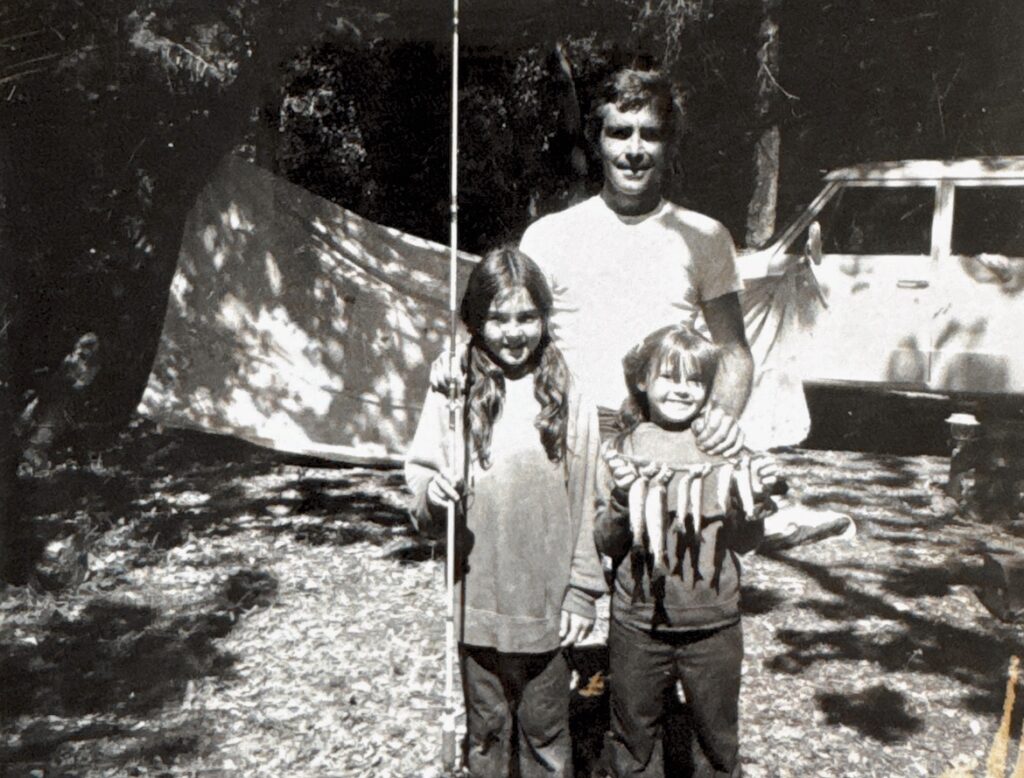
Camping and fishing. I’m on the left and my sister’s on the right, both of us proudly holding up our catch while Dad stands behind us. He taught us to fish—“Now, put your hook right in that dark spot over by the rock. They like to hide there.”—and to use a knife and clean the fish—“Slice them down the belly, then scoop out the guts.” Mom dipped them in cornmeal and fried them up for dinner. I’ve been a fishergirl ever since.
My father loved National Geographic magazines. They arrived month after month for years — thick, glossy issues with gold-bordered covers and exotic pictures inside. Nearly every page showed something I had never seen in person. Cheetahs stretched mid-stride across African plains. Crowded markets in Morocco shimmered with kaleidoscopic colors and textures. Ancient cities appeared in places I couldn’t even imagine.
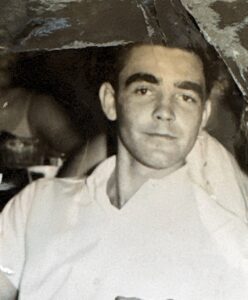
My dad as a young man, during the years the Navy took him around the world.
Before the internet, those pages were a window to the wider world. Dad would sit and turn them slowly, studying the photographs. I never knew which foreign ports the Navy took him to, but I knew he loved those magazines and that somehow, the two were connected in a good way. When we talked about those foreign places, his eyes sparkled with wonder.
This was my father.
One time, as we flipped through those pages—I don’t remember the subject or the year—he looked at me and said, with great conviction, “You have to be careful when you travel. There are places in the world where if you steal, they chop off your hand!”
Wherever “over there” was, it didn’t matter. I was here.
And here felt safe.
Except in my nightmares.
The Nightmare That Still Haunts Me
For years—through much of my life—the same dream returns.
Tanks—like the ones in old World War II movies—roll up the street in front of the house where I grew up. We lived in a middle-class neighborhood in California, an hour’s drive from San Francisco, where rows of nearly identical houses blanket the rolling hills like a rooftop mosaic. The tanks rumble up my street, metal grinding against modern asphalt. Just like in the movies, soldiers storm our house to take us away.
In my nightmare, my plan never changes: I run to my sister’s bedroom and climb into the attic through a small opening in the ceiling.
But I never make it.
I am too small. And it is too high.
The dream always ends when I jolt awake, suspended for a fractured moment between racing-heart terror and the safety of my bed.
I do not remember when in my life those nightmares began. I only know they are as much a part of me as any other detail that makes me who I am, though their frequency has waned.
They still taunt me.
Given the state of the world, I sometimes wonder: are they a premonition?
The Images I Couldn’t Unsee
In high school, I met the boy who would become my husband. As long as we’ve been together (46 years as of this writing), Ron has watched World War II documentaries. The television in our house has always hummed with the steady drum of a masculine narrator shouting above the roar of aircraft engines and exploding ships.
I watched images of Japanese planes crashing into ships — on purpose (!).
I saw soldiers running straight toward enemy fire. I saw buildings and entire cities burn to ashes like kindling. But the scenes that frightened me most were not about combat. They were the aftermath. The barbed-wire compounds. Piles of corpses. And seeing skeletal prisoners so starved, I forgot to breathe.
Once those images seared themselves into my soul, they never left.
At first, I resented them. I felt as though something awful had been placed into me that could not be removed.
But curiosity has always won with me.
I began watching more closely. Listening more deeply. Reading survivor memoirs. Night. Maus. And eventually, Anne Frank’s diary.
In my fifties, I began to use the Holocaust as a kind of measuring rod. When I encountered difficult questions—about morality, about suffering, about power—I measured them against it.
If I were trying to understand something about the world—about humanity—about whether God exists—I held it up to that.
Eventually, that measuring rod led me to Europe.
Walking Where It Happened
Inside the Anne Frank House
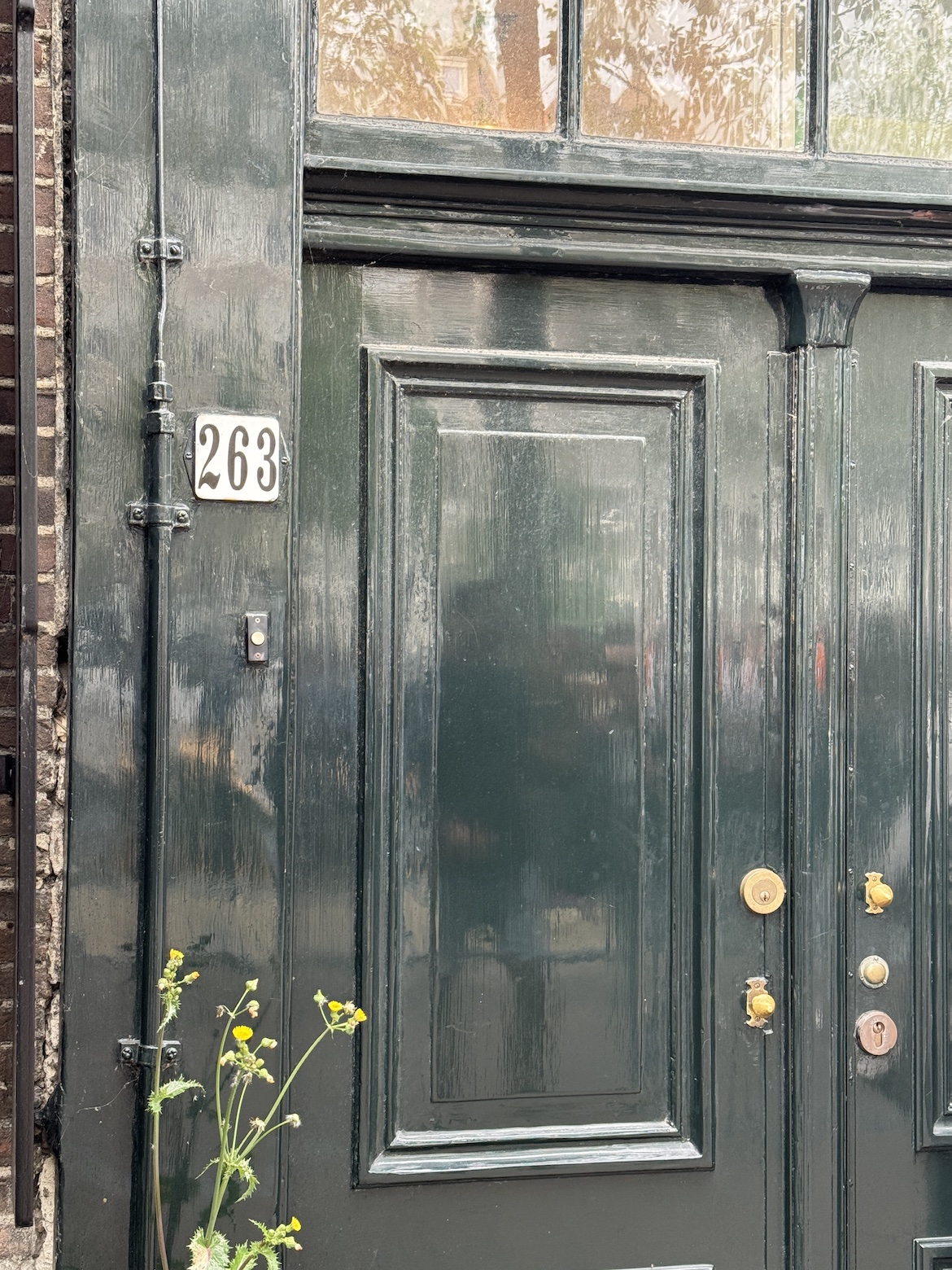
The door to the Anne Frank House. Standing there felt surreal and deeply profound.
I made visiting the Anne Frank House in Amsterdam the seed of our 33-day trip to Europe in 2024. I wanted to stand in that house and breathe in history. I wanted to climb the narrow staircase and look out the attic window to see the chestnut tree Anne Frank wrote about in her diary, one of her few glimpses of the outside world. I wanted to understand how ordinary walls could conceal both hope and terror.
Standing there did not reveal any answers. But it reminded me of my tank nightmares. And I wondered: if this happened here, could it happen anywhere?
Ron and I traveled through five countries on that trip. We sailed the Rhine River, docking in medieval towns along the way. Castles. Museums. Gothic cathedrals that left me gob-smacked. Rolling green hills dotted with monuments to former heroes and hard-fought battles.
No matter where I have traveled in the world throughout my life, evidence of past wars proves to me that in human history, no people or place is immune to violent conflict.
D-Day in Bayeux
Later in that trip, we arrived in Bayeux, France during the 80th anniversary week of D-Day—a coincidence we had not planned. American, British, and Canadian flags crisscrossed the medieval streets.
All the shops, businesses, and café windows displayed hand-painted scenes—red poppies stretching across glass, paratroopers floating through pale blue skies, nurses in white uniforms and matching caps greeting passersby.
Cobblestone streets. Medieval stone buildings. Flags strung across narrow lanes. Everywhere I looked, the words “Thank You!” and “Merci!” were painted in bright, cheerful letters.
It wasn’t one shop.
It was every shop.
Window after window carried the same unmistakable style—bright colors and cheerful 1940s wartime scenes—as if one artist had painted the entire town.
I was thousands of miles from home in a place completely unfamiliar to me and American flags were everywhere. It felt personal.
Click (or tap) any photo to open the gallery, see the full image, captions, and scroll through the set.
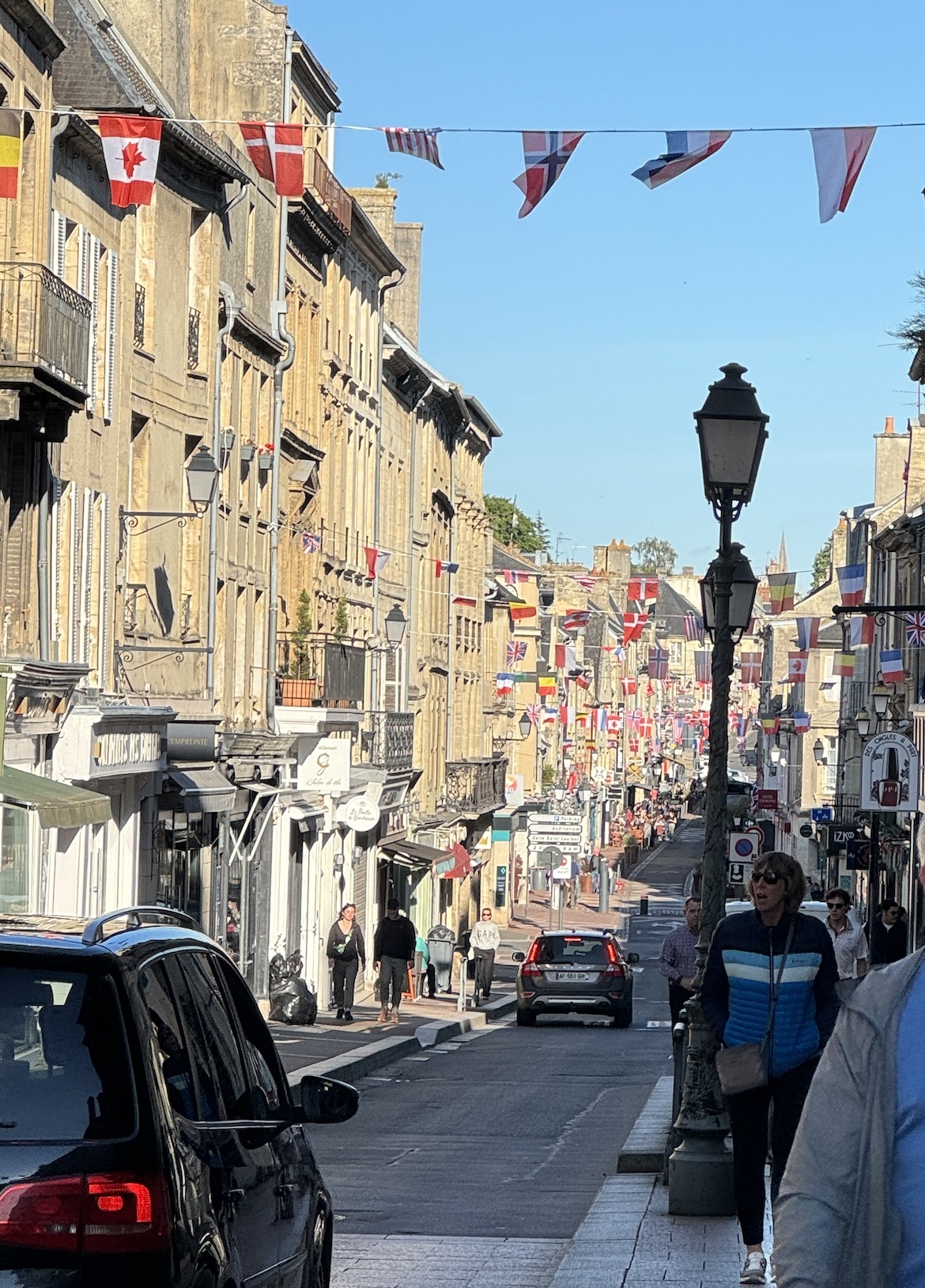
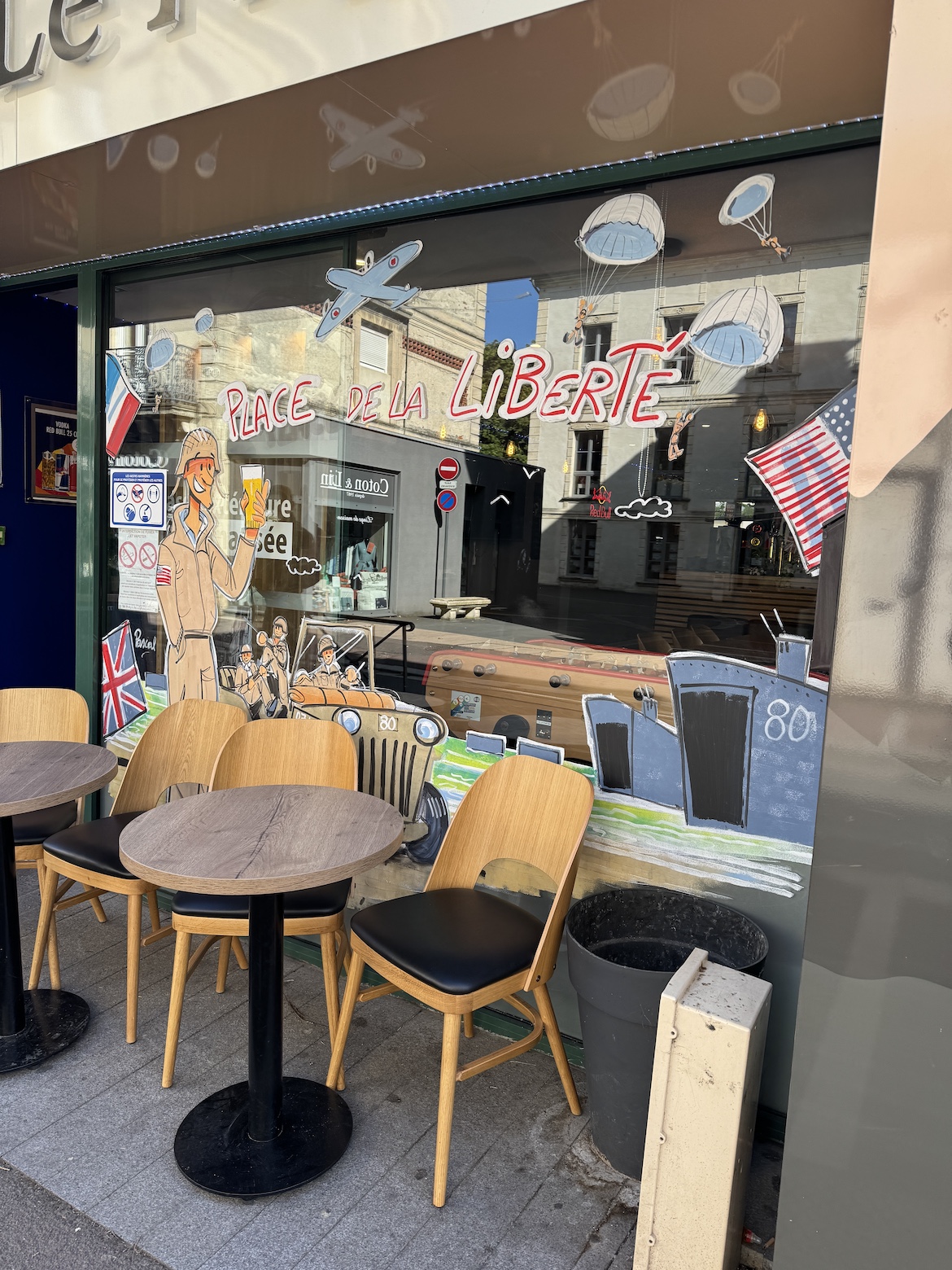
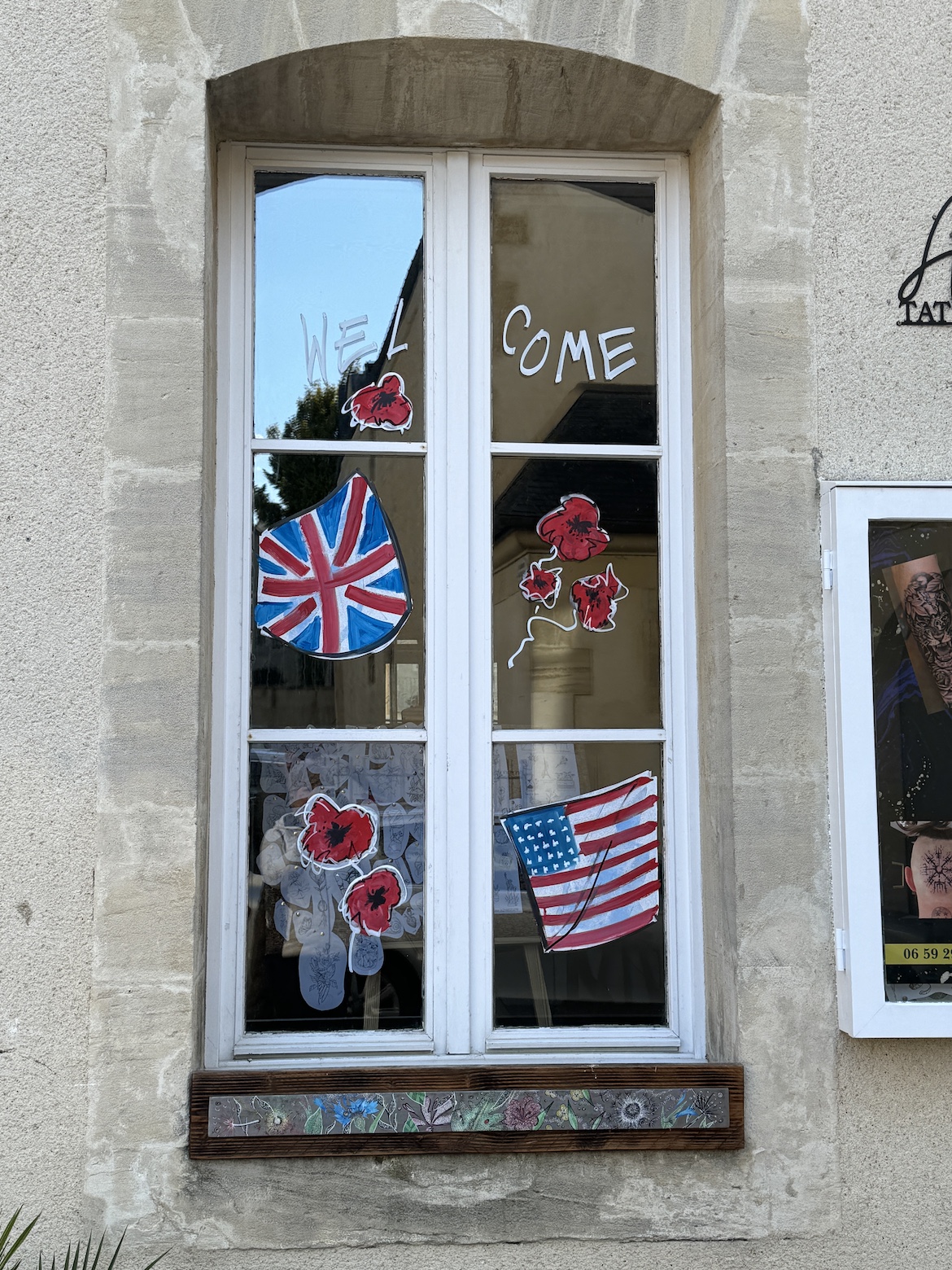
Even at Pointe du Hoc, the cliff where U.S. Army Rangers climbed under enemy fire on D-Day, the ocean wind joined in, whipping American flags into celebratory revelry.
Gratitude. Celebration. Honor.
I stood taller. I smiled wider. I had never been more proud.
But not all the places we visited left me feeling elated. Beyond the bustle of modern life, memorials, plaques, and statues — reminders everywhere of wartime—plead for remembrance, so that what happened there will never happen again.
Of all those remembrances, nothing moved me more than the Stolpersteine.
Sidewalks Across Europe
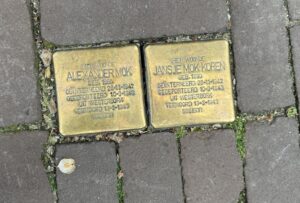
Here lived Alexander Mok and Jansje Mok-Koren. Both were deported through Westerbork and murdered at Sobibor in March 1943.
In city after city, I bent to read Stolpersteines, small brass “stumbling stones” embedded in sidewalks. Each stone bears the name, birth year, deportation date, and place and year of death of a victim of the Nazi regime during the Holocaust. A cluster of stones depicts an entire family who perished.
Names are set into the pavement as permanent witnesses, reminding us of those who once freely lived at that very spot.
The Holocaust is not abstract.
You can stand where it happened.
You can read the diaries.
You can say the names.
Standing over those stones, I realized something only being there—exactly there—could illuminate.
These were not distant figures from history books.
Every name represented an ordinary life just like mine.
I felt connected to them.
I sensed their presence.
Standing in that exact place, breathing that same air, I felt as if I were absorbing the molecules of their existence.
Pictures and stories had never given me the tools to truly grasp the Holocaust’s profundity.
Their deaths became personal.
And I finally understood—physically, not abstractly—that what happened to them could happen to anyone.
And the more I tried to understand the Holocaust, the more another question pressed forward.
When Faith Began to Fracture
As a child, I prayed every night. I was not taught to do this. Religion never settled in our household, so looking back it seems an odd choice. Perhaps friends or television shows influenced me. But I wanted to be dutiful. I felt thankful. And prayer felt like the right way to express myself.
Now I lay me down to sleep
I pray the Lord my soul to keep,
If I should die before I wake,
I pray the lord my soul to take
The practice continued into my adulthood. I thanked God for my husband and children. For our health. For our home. I asked for healing for my mother who suffered chronic pain. I asked for peace for my parents. And for people I loved who needed help.
God never answered.
As I learned more about the Holocaust—not just death, but systematic cruelty, torture, experimentation, the murder of children and of faithful people praying for deliverance—I found myself asking a larger question:
If there is a God who is all-powerful and intervening, how could He allow that?
Years passed. My belief loosened. Then logic and experience unraveled it.
I did not leave faith in rebellion. I left because I could not reconcile history with divine intention.
I arrived at a conclusion I could no longer avoid: I do not believe in any gods—not one—not any of the thousands people worship throughout the world.
And beyond that, what makes people evil? What made those evil men do evil things?
That question haunted me for years.
Until I watched Nuremberg.
What Happened at the Nuremberg Trials
The Nuremberg trials were the Allied prosecution of high-ranking Nazi officials after World War II. Among those on trial was Hermann Göring—second only to Hitler in the Nazi hierarchy. He was charged with war crimes, crimes against humanity, and conspiracy to wage aggressive war.
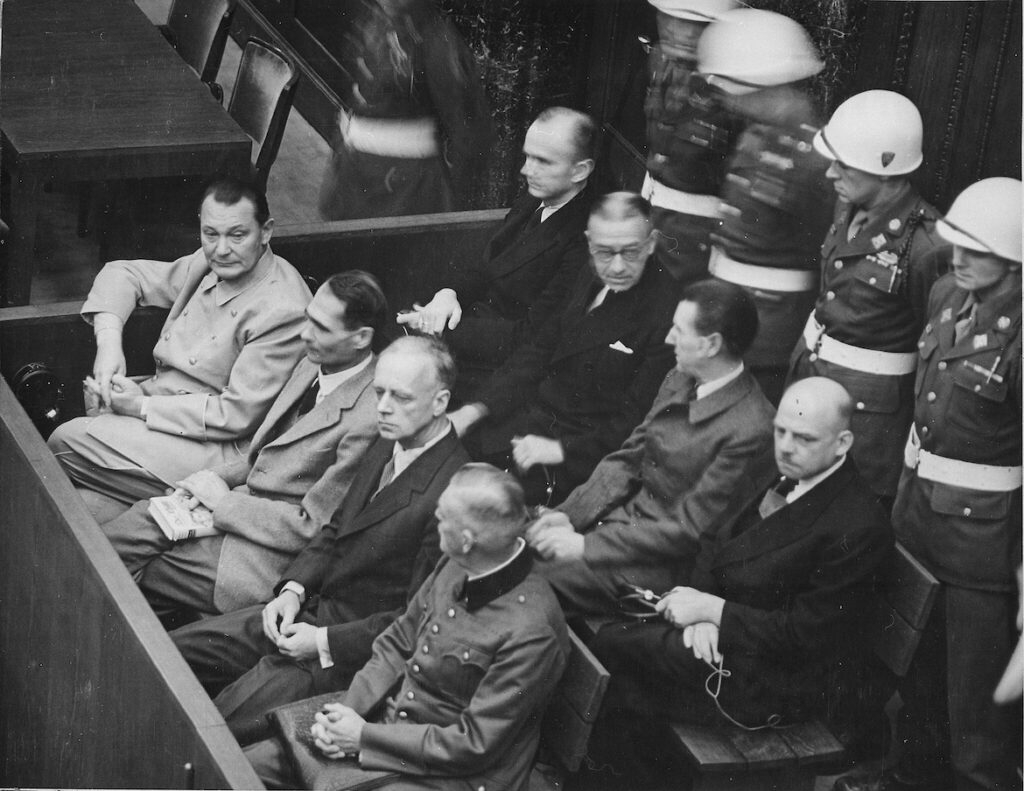
Hermann Göring sits at the far left — the man who was next in command after Hitler — alongside other high-ranking Nazi officials during the Nuremberg trials, 1945–1946. The court later sentenced many of these men to death or long imprisonment for war crimes and crimes against humanity.
An American Army psychiatrist, Douglas Kelley, was assigned to evaluate the mental state of the Nazi defendants to determine whether they were legally sane enough to stand trial. His task was to understand the psychology of the men who had carried out the regime’s crimes—horrific crimes. He interviewed Göring for months.
He expected madness. But what he found, haunted him:
The German officers were not deranged monsters.
They were intelligent. Strategic. Ideological. Ambitious. But not monsters.
Kelley concluded that what made them dangerous was not insanity. It was ideology combined with ambition and a willingness to be cruel.
He later wrote 22 Cells in Nuremberg, warning that what happened in Nazi Germany was not a national defect. It was human nature untethered from conscience.
Another psychiatrist at the time offered a more comforting interpretation — that the perpetrators were aberrations, anomalies, safely distant from ordinary society. That explanation was easier for the world to accept.
Kelley’s was not.
When I watched the film and learned his conclusion, something inside me aligned. In that moment, the question that had followed me since childhood finally had an answer.
What did the Nuremberg trials reveal about human nature?
No nation is immune.
The danger is not geographic.
It is human.
For a long time, I wondered if the Holocaust was simply the result of madness.
Perhaps Germany attracted psychotic people and the powers that be simply allowed it.
That explanation would be more comforting.
If evil belongs only to a small subset of sick individuals, then the rest of us are safe. We can isolate psychotics.
But that is precisely what Douglas Kelley rejected.
He expected madness.
He found rational men.
Not frothing.
Not delusional.
Not clinically insane.
Ideological.
Ambitious.
Detached.
Moral reasoning overridden.
That is far more disturbing.
Because if it were just psychotics, the world would be safer.
But if ordinary, educated, strategic men can operate inside a system that rewards cruelty — then the danger is not psychological.
It is structural.
Cultural.
Human.
And that is why the Holocaust still feels different to me.
History is full of cruelty. Torture did not begin in Nazi Germany.
Ancient Rome tortured.
Medieval Europe tortured.
The Inquisition tortured.
Imperial Japan tortured.
Colonial regimes tortured.
Wars have always involved rape, mutilation, cruelty beyond necessity.
But the Holocaust introduced something else.
It was industrialized.
It was bureaucratized.
It was state-engineered.
It ran on paperwork, rail schedules, doctors, laboratories.
Elimination became policy.
Not the chaos of war.
System.
That is why it became my measuring rod.
Not because humans had never tortured before—but because modern civilization proved it could organize cruelty.
For a long time I hoped the explanation was madness. That only deranged people could do such things.
But what history shows—and what Kelley saw—is something harder to accept.
Cruelty does not require insanity.
It requires ideology.
And permission.
War seeks victory.
The Holocaust sought eradication.
War kills to win.
The Holocaust killed to purify.
War is conflict.
The Holocaust was extermination.
My Epiphany
Watching that film did not change my beliefs. It clarified them.
It helped me understand why I have measured difficult moral questions against the Holocaust. It helped me understand why I no longer believe in God—not in anger, not in defiance, but in reconciliation with what history reveals and with what I have experienced myself.
Evil is human, not geographic.
But so is goodness.
The few who crave domination do not outnumber the many good and decent people.
And that aligns with my experience in every country I have traveled to.
Kindness appears more often than cruelty.
Help appears more often than harm.
Compassion is an antidote.
No nation is exempt. But neither is any nation defined solely by its worst offenders.
It’s simply the human condition.
And the same human condition that festers cruelty can also forge compassion.
And that is where I find hope.
Because most people choose decency.
We all—the good people—know who we are.
We aren’t in peril for choosing the right side.
We need to stay vigilant about those who aren’t.
No nation is immune.
5 comments
This is an excellent piece of writing Deborah! How lucky you were to be there for D-Day! I read historical fiction about WWII all the time, but don’t think I can bring myself to watch the Nuremburg trials. I think it would be too intense for me. The blocks with the names in the sidewalks and streets were the most meaningful thing I saw on our trip. I found it encouraging that there is a way that those lost to the Holocaust have permanent reminders for the rest of us of what humans did to their fellow humans.
Thank you, Karen. As this is the most personal piece I’ve ever written—and divulged—I feel particularly vulnerable. But I also feel relieved, having wrestled with the content for so long. Writing forces me to solve the swirling ideas in my brain—and soul, it appears. I’m thrilled it resonated with you.
—
Regarding the movie Nuremberg, 2025, if you have any interest in WWII history, which it seems you do, I’m certain you will find this movie valuable. (And I hope other dear readers will find it valuable, too.) I found it absolutely riveting. Besides the terrific acting and production of the movie itself, the profound, historically accurate, conclusion ignited a firework frenzy of thoughts and feelings for me.
But take heart—the movie focuses on the relationship between Göring and the psychiatrist, and less on the details of their horrific crimes, as well as how the whole court came to be (equally fascinating). In a courtroom scene, they do show some historical, actual photos and videos, but they do not delve into the specific atrocities, nor do they languish on the subject. I’m certain we have all seen much, much more graphic images on television throughout our lives. It’s included, but not central to the plot.
I highly recommend Nuremberg (2025) and would love to discuss it further. 🌻 I love discussing movies in general and rarely find someone who enjoys a deep dive into serious subjects—even more so when it comes to WWII content. In fact, to date, there is only my husband.
—
Thank you so much for taking the time to comment and connect. 💫
Karen—I felt compelled to reach out again.
It really struck me how much overlap there is in what you shared—the travel, the impact of the stumbling stones, and even the WWII thread. It’s kind of amazing to think we were across the world, likely around the same time, and felt so many of the same things.
Small world, in the best way. 🦋
Thank you for sharing this. I know you’ve stated you don’t believe in God and you don’t think that he answered your prayers. I would say that you live an amazing life full of family, a wonderful husband. To me those are answered prayers. I know we’ve had our conversations and you you know my why. God does answer prayers and I do believe he has answered yours as well. Be Well, my friend.
Debra ~ I’m happy for you, and for so many others for whom faith is paramount. I’m glad you have it.
My prayers were mostly focused on my mother, who lived in chronic pain from an injury, as well as on family members and friends in need.
In any case, I am certainly fortunate; not an iota of doubt there. Thank you, Debra, for your perspective and kind words. 🦋