
The possession of knowledge does not kill the sense of wonder and mystery. There is always more mystery.
I bought this little plant a very long time ago.
At the time, it was sold as a Rose of Jericho, which is how many people still know it. It looked dry and brown and curled in on itself, but I remember being told it would come back to life if you added water.
This fact fascinated me. Too curious, I bought it.
I watered it. It unfolded and turned green. Then I let it dry and put it in a cupboard. It looked like a dried up weed so I had to put it away.
More than a decade later, I took it out. “That’s dead. You should throw it out,” my husband said. “How long have you had that thing anyway?”
“Well, let’s see….I last watered it about, oh, 13 years ago.” I said.
It spent all those years dry, tucked away, completely forgotten. And this week, for only the third time since I bought it, I decided to give it water again.
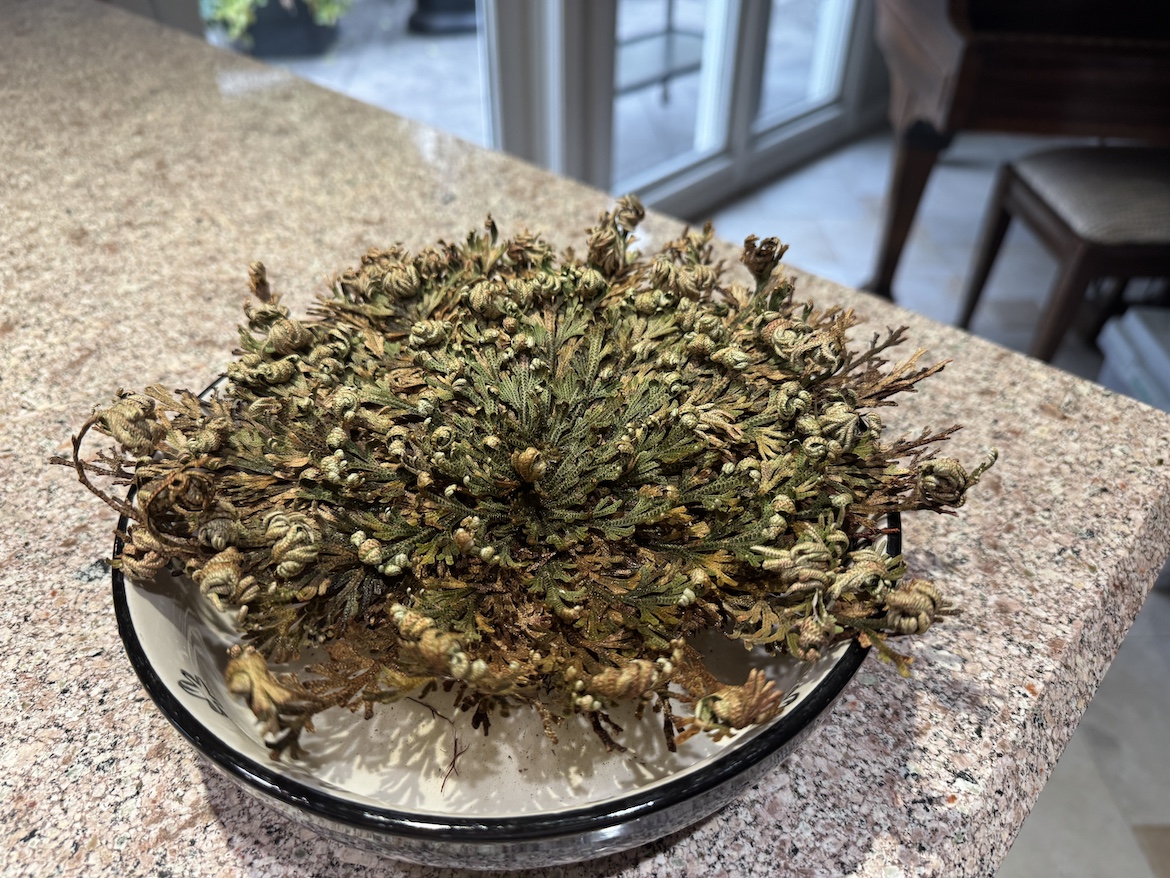
Within an hour, it started to open. Fast enough that my eye caught the movement as I walked past. The outer leaves seemed to fling themselves outward, one by one, slowly, every so often. Ping!……..Ping! Like a gentle wind had blown open a door.
By the next morning, it had completely opened, laying flat in the bowl, and the center had turned a bright, vivid green—almost like a tiny Christmas tree that had been brought to life.
I find it endlessly fascinating.
About the Name: Rose of Jericho
Before going any further, there’s something important to clear up—because the name Rose of Jericho is misleading.
There are actually two completely different plants sold under that name.
The original Rose of Jericho comes from the Middle East. It dries up, curls into a ball, and opens when it gets wet—but it stays brown. It doesn’t truly come back to life. The movement is more mechanical than biological.
The plant I have—the one most people now call the resurrection plant—is different. This is the true one. It actually turns green again. It resumes photosynthesis. It can sit dry for years and then fully reactivate.
So when people call it the Rose of Jericho, they’re borrowing a name that already existed because the idea fit—even if the science didn’t quite line up. That’s almost certainly what happened when I bought mine.
What This Plant Does With Time
What makes this plant so unusual is how it handles time.
When it dries out, it doesn’t die. It shuts down. It loses almost all of its internal moisture. Growth stops. Aging pauses. It curls in on itself to protect what matters.
In that state, it can sit for months. Years. Even decades.
Apparently, thirteen years in a cupboard is no problem at all.
Add water, and the whole system starts back up again. Cells rehydrate. Chlorophyll wakes up. Photosynthesis resumes. The plant opens because it’s built to open.
There’s nothing fragile about it, but it certainly feels magical.
Why You’re Not Supposed to Keep It Green
This is also where people tend to get confused.
This plant isn’t meant to stay open and green all the time. It isn’t a houseplant in the usual sense. It doesn’t want soil. It doesn’t want fertilizer. And it definitely doesn’t want to stay wet.
In nature, it may only be green for a few days in an entire year. Constant moisture actually shortens its life and leads to rot. I’ve learned the best way to think about it is to pretend it lives in the desert and gets an occasional, rare rain shower.
So after a day or two, I’ll pour the water off. I’ll let it dry completely. And eventually, it will curl back into itself again—right on schedule.
That isn’t neglect. That’s how it survives.
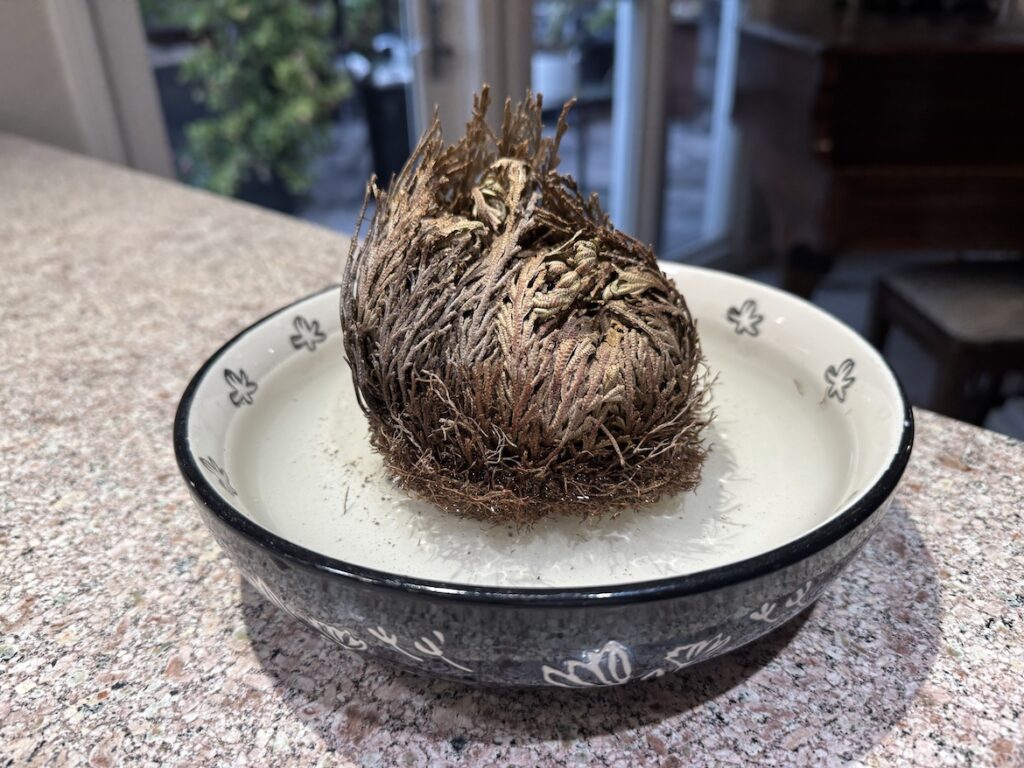
My Rose of Jericho in its dormant state before adding water.
Why I’ve Kept It This Long
I’ve owned this plant longer than most furniture. I don’t feel right tossing it out, yet it doesn’t look great sitting out.
It looks dead. It simply waits until conditions are right—and then it opens fully, without hesitation. How could I toss a living thing?
I do feel the need to nurture it. To feed it. Perhaps even talk to it. (Hey, hasn’t science proven that plants like being talked to and that they like listening to music, too?)
Instead of putting it back in the cupboard again, though, I’ve decided to display it in a creative vase of some sort. And down the road, even if it is years from now, I will set it in water.
I already know what will happen.
It will open.
4 comments
We have resurrection ferns in our oak trees! We only learned about them a few years ago. It’s amazing how quickly they turn green and then turn brown again.
I didn’t know they grow in trees!
I just think they are fascinating. So unique and seemingly archaic. Life always finds a way. Perhaps they should be called the Hope plant.
This is so cool! I haven’t heard of this plant before. This is probably the perfect plant for me since I didn’t get the green thumb in the family.
Too funny! Yes. I do believe this is the perfect plant for those of us who want to be good plant parents, but aren’t. But not for lack of trying. Even with this plant, I’m glad I learned that too much water can kill them. I always want to give them more water thinking that they need it after having been deprived. Too much love I guess isn’t a good thing!