

You know that Aha! moment when you feel your perspective shift? The slight head tilt that follows? The slow nod?
That’s exactly what happened when I stumbled onto an interview Mel Robbins did with Dr. Angela Duckworth.
First: let me just say, happenstance is highly underrated.
Maybe it’s because ideas slip in more easily when we’re caught off guard, when we aren’t busy defending our well-worn beliefs.
How I Landed in Mel Robbins’ World
I found my way to Mel because how could I not? She’s everywhere. Her book The Let Them Theory is #1. Her podcast is ranked #1 in the world. And there’s good reason for that. Mel is engaging, smart, down-to-earth, and makes you feel like you’re on a let’s-go-get-a-coffee basis—as evidenced by the fact that I call her Mel, not something more formal or fitting like Mrs. Robbins.
A Visual Communicator Meets Podcasts
I don’t usually listen to podcasts. I’m a visual person through and through, and body language matters a great deal to me. So I’m glad I found a YouTube version of this episode. Watching it helped me understand why people love podcasts in the first place. And if you’re going to dip a toe into the world of podcasts, starting with the #1 show in the world doesn’t hurt.
Mel Robbins’ Interview With Dr. Angela Duckworth (Podcast Episode)
In this episode, Mel interviews Dr. Angela Duckworth.
The title Mel gives the episode, This Is What Success Looks Like might not appeal at first glance to the average viewer. It sounds like a conversation about business or achievement. But this episode is packed with lessons that help in everyday life, not just professional goals. So don’t skip this one.

Just Change One Word
The part that made the most difference for me is when Dr. Duckworth’s advises us to use the word want instead of should.
I’ve always pushed myself. I’m very motivated and relentless when pursuing a goal I’ve set my mind to. Especially the big stuff like marriage, children, career. But in every day living—eating healthy, exercising regularly— I often lack motivation. It’s too easy in retirement to ‘get to that later’.
But Dr. Duckworth’s simple, almost off-the-cuff remark of simply changing one word, really resonated with me. So I’ve started following her advice and changing that word should to want, and you know what? It works. Just changing that one word is making a difference.
I no longer say:
— I should work out.
— I should eat veggies instead of pizza.
— I should paint the bathroom.
Now I shift the word should to want… and it changes everything.
— I want to work out because I know I’ll feel better.
— I want to eat a salad instead of pizza.
— I want to paint the bathroom and give it a refresh.
Dr. Duckworth says: Just ask yourself a different question.
She learned to ban the word should from her vocabulary after her therapist suggested it. And now I do. The practice is literally therapist approved.
She talks about this around the 37-minute mark in the video.
Choose Easy, Then Work Hard
Dr. Duckworth also talks about choosing your future. “Choose easy. Then work hard,” she says. Intuitively that advice sounds awful. But, she gives wonderful examples of how this works. And I’m all in.
Because if a choice is easy, it’s likely what you really want.
For example, if you really want to become a doctor, the hard work is simply part of the deal. You accept it. But if you don’t really want to become a doctor, perhaps you’re trying to appease a family member or pursuing that profession for reasons other than your heartfelt desire, that hard work is exponentially harder.
She tells an enlightening story at 33:13 about a man who has never made a decision that was easy or enjoyable to him, decisions that gave him energy or made him feel alive—he’d always made decisions based on the idea that harder was better. But Dr. Duckworth teaches that it’s two stages. Choose easy and then work hard.
Mind blown.
I relate to the man’s thinking that harder is somehow better. In fact, I remember telling myself while raising my kids and my nephews that, “If I just work hard enough [in college, and in my career], all my dreams will come true.” I did. And they did. But I think I would have found my career choice years sooner, and been happier in the process following this advice. I mean, I really struggled in those early years trying to figure out my future in terms of my life’s purpose outside my family.
I just love how Dr. Duckworth breaks it all down.
Episode Breakdown
00:00 Meet the Guest
05:43 Rewire Your Brain for Success
13:30 Inside the Mind of Top Performers
17:15 The Truth About Talent and Why It’s Not Enough
23:03 How to Figure Out What You’re Interested In
36:00 Use the Word Want Instead of Should
43:15 Why You’re Not Getting Better (Even Though You’re Trying)
01:00:58 The Step by Step Guide to Finding Your Passion
01:15:17 How to Achieve Your Most Ambitious Goals
01:25:02 How to Stop Letting Your Phone Run Your Life
The Bricklayer Parable
Another wonderful moment is when Mel reads Duckworth’s bricklayer parable. It’s simple and relatable: three bricklayers doing the same job, but each one describing their work differently. One says he’s laying bricks. One says he’s building a wall. The third says he’s building a cathedral.
Same task. Completely different meaning.
It’s a reminder that how we frame what we’re doing changes how it feels. That’s the part that hit me. It made me think about the small things I do each day, and how I might simply shift my thinking and move on with purpose.
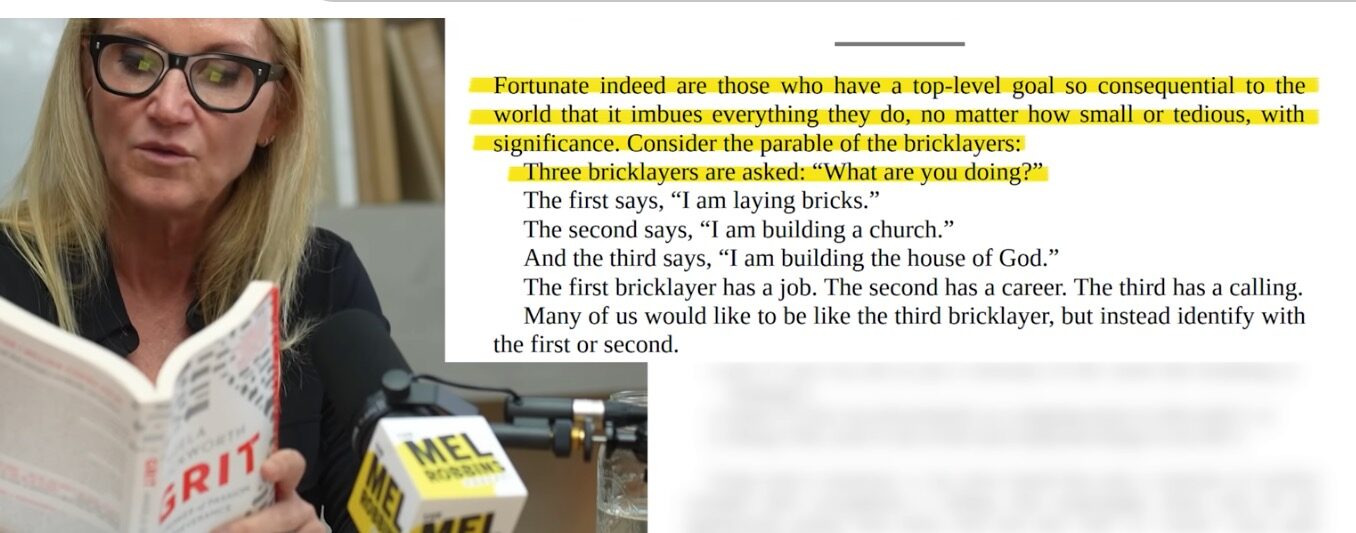
Brick Layer parable
Mel Robbins’ New Book Absolutely Rocks (The Let Them Theory)
I learned about Mel Robbins because of her book The Let Them Theory. What a remarkable book. Her guidelines work and I use them daily. It reminded me of something I know at a cellular level: you can’t change other people, so let it go.
It’s the grown-up version of Tough Love—with a twist. In my early 20s, I attended Tough Love meetings trying to learn how to help and cope with family members. Tough Love teaches you to stop rescuing people, stop enabling them, and let them face the natural consequences of their choices. The Let Them Theory overlaps with those ideas, but it goes farther. It shifts the focus back to you—your peace, your boundaries, and the freedom that comes from letting people be who they are. It also adds a Let Me factor, which I found refreshing and immediately helpful. Read my book review here where I highly recommend this book.
Grit by Angela Duckworth, PhD
Learn more about Dr. Duckworth here.
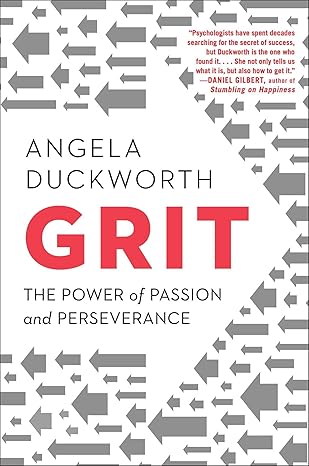
About GRIT
Per Amazon:
In this instant New York Times bestseller, pioneering psychologist Angela Duckworth shows anyone striving to succeed—be it parents, students, educators, athletes, or business people—that the secret to outstanding achievement is not talent but a special blend of passion and persistence she calls grit.
Drawing on her own powerful story as the daughter of a scientist who frequently noted her lack of genius, Duckworth, now a celebrated researcher and professor, describes her early eye-opening stints in teaching, business consulting, and neuroscience, which led to the hypothesis that what really drives success is not genius but a unique combination of passion and long-term perseverance.
In Grit, she takes readers into the field to visit cadets struggling through their first days at West Point, teachers working in some of the toughest schools, and young finalists in the National Spelling Bee. She also mines fascinating insights from history and shows what can be gleaned from modern experiments in peak performance. Finally, she shares what she’s learned from interviewing dozens of high achievers—from JP Morgan CEO Jamie Dimon to New Yorker cartoon editor Bob Mankoff to Seattle Seahawks Coach Pete Carroll.
Among Grit’s most valuable insights:
-
Why any effort you make ultimately counts twice toward your goal
-
How grit can be learned, regardless of I.Q. or circumstances
-
How lifelong interest is triggered
-
How much of optimal practice is suffering and how much ecstasy
-
Which is better for your child—a warm embrace or high standards
-
The magic of the Hard Thing Rule
Winningly personal, insightful, and even life-changing, Grit is an inspiring self-improvement book about overcoming obstacles and what goes through your head when you fall down, and how that—not talent or luck—makes all the difference.
Subscribe for my newest posts and Links & Lovelies—thoughtful finds and inspirations I only share with subscribers.