
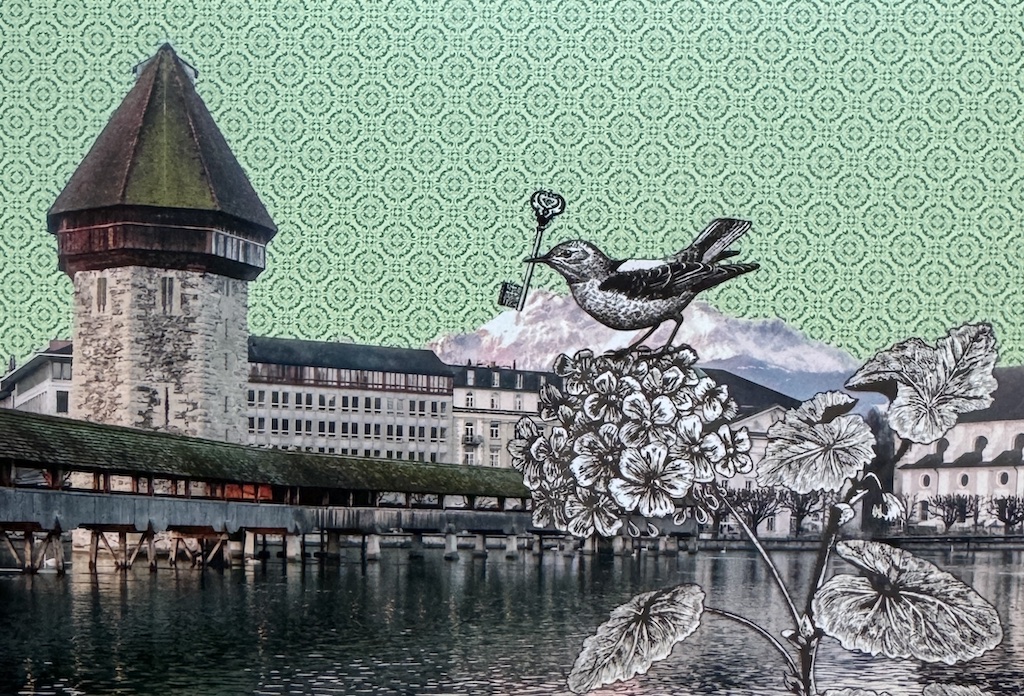

What you have never seen, you find where you have never been.”
This is part of the 33 Days in Europe series—your starting point is the hub page here.
❦
Planning a trip can be overwhelming. When I first started traveling, I didn’t even know where to begin. Over the years, I’ve developed a more intuitive way to approach travel—one that helps everything fall into place. I call it the Red Pillow Method.
The Red Pillow Method: Choose One Thing
Years ago, when I was out and about, I came across a picture I loved. It didn’t match anything in my home—not the style, not the color—but I hung it in the guest bathroom anyway. That picture led to a full remodel: custom tile, a new vanity, a handcrafted mirror from Pier One. That one picture became the catalyst for redoing the whole house. My husband Ron still jokes, “We remodeled the entire house based on a single picture.”
That picture held a feeling. I couldn’t describe it at the time, but I knew it was right.
That’s how I plan trips now—big or small. I choose one thing—a single anchor—and build everything around it.
For example, when my niece Nicole and I planned a girls’ day in San Francisco, we picked one odd little goal: find a red pillow. I don’t even remember why I wanted one—it might’ve been a whim—but it gave us a direction. We chose a neighborhood in the city that seemed likely to have options. That led us to a local boutique, then lunch, then some urban wandering and drinks—and before we knew it, we had an entire day, perfectly built around that small, arbitrary desire.
We’ve done this many times. Need local raw honey? That turns into a day at the San Francisco Farmers Market. But it doesn’t stop there. We end up at the Ferry Building’s little bookstore, grab warm bomboloni filled with crème from the Italian donut cart, sip gourmet coffee, pick out fresh, unique-to-me flowers, and wander past the artisan booths across the street. I usually come home with something unexpected. Last time, I bought a watercolor of the San Francisco skyline—by a wonderful artist, perfect for my guest bathroom—a pair of gemstone earrings from a local jeweler, and a few special items for gifts. All because we started with honey.
Other times, it starts with a birthday gift. Or a special occasion outfit. Or a Thanksgiving serving platter. I ask: what’s the one thing I need today? And I let that be the compass.
I’ve come to trust that choosing one thing—no matter how small—is the best way to plan a meaningful day. And now, it’s how I plan entire trips.
Once I’ve chosen my Red Pillow—the one meaningful thing that draws me in—I build the rest of my travel planning around it.
Applying the Red Pillow to Europe
When it came to planning this 33-day trip, I didn’t start with a destination. That was too overwhelming.
Where in the world did we want to go?
Instead, Ron and I asked ourselves: What’s pulling at us? What are we curious about? What are we craving?
At the time, I’d been reading memoirs on the Holocaust. I couldn’t stop thinking about Anne Frank. What was it really like for her? How could her and her family hide for two years—with eight people in all, with a shortage of food? I wanted to understand—not just intellectually, but viscerally. I wanted to walk those narrow stairs, breathe the stale attic air, hear the creak of the wood beneath my feet.
That became my red pillow: Anne Frank’s House. That meant Amsterdam. From there, we built outward.
Rick Steves: My Planning Mastermind
Once we knew Amsterdam was on the list, we turned to Rick Steves. He’s our go-to for all European planning. He recommends places to stay that are affordable, practical, and thoughtfully chosen. They’re the places he stays himself. There’s a genuineness to his approach—boutique hotels, locally owned inns, and places with a sense of story. He usually offers five to eight hotel options for each area, which means that once I determine the area I want to visit, I only have to look through his list and make a decision. He removes the overwhelm.
I’m pretty particular about where I stay, and every place we’ve booked through his recommendations has not only met my standards—they’ve often surprised me in the best way. And they’re always true to the local culture. Rick Steves is keen on this point—it’s his whole shtick. He carefully curates his choices and describes them honestly. I completely trust his judgment.
You can visit his website to get sample itineraries and inspiration, and then buy his books on specific regions for every little travel detail. It’s all there. We’ve used this tactic for every single trip to Europe, and it’s proven perfect. Just make sure you get his most recent, updated version. We don’t follow his outlines exactly, but his insights help us tune into what feels right. It’s like having a travel-savvy friend guiding you along. We also ask questions in the online forum—there are so many travelers eager to help. No detail is too small.
The Unexpected Switzerland Detour
We were also feeling drawn to Switzerland—though when we looked at the map, it didn’t exactly fit. It was an outlier. But something about it felt magical. I couldn’t even say why. Something Rick Steves wrote stirred something in us—set our solar plexuses spinning—and suddenly, Switzerland didn’t seem like an outlier at all. It felt like somewhere we needed to visit.
But how would we get from Switzerland to Amsterdam and still see the best of what lay in between? How could we pass through that part of Europe and not see the famous castles and medieval towns? Renting a car would have eaten up more of our time than it was worth—time we’d rather spend actually seeing the sights.
Then I got a Viking River Cruise catalog in the mail. We are not cruise people. We had never been on any cruise and had no desire to. It’s just not our style. Too many people. Too commercial. But a friend (thanks, Sue!) had recently recommended a Viking river cruise, and this one brochure caught my eye.
Basel to Amsterdam. On the Rhine. One room left.
I assumed it would be the worst room (because that’s how “one room left” usually works), but I looked it up. No inferior rooms on a Viking ship. We got a “swan” room—below water level, yes—but strikingly beautiful and still with a window—at water level, with the swans. It felt serendipitous. And with only 169 people on board, we could be social, but not overwhelmed. No rental cars needed. No figuring out how to get to castles and medieval towns tucked away. Just step aboard and float through storybook surroundings with shore excursions and expert guides. Think castles and spires!
Building the Itinerary
With Amsterdam and Switzerland as anchors, we filled in the rest. Ron loves beer and I love chocolate (duh!), so Belgium felt just right. We even found a few significant WWII sites along the way.
Then Bayeux, in Normandy—the first town liberated by the Allies. That meant we could visit Pointe du Hoc and the Overlord Museum. But Bayeux also has a medieval center, a stunning cathedral, and the famous tapestry that chronicles the Norman conquest. Historic, semi-coastal and walkable—perfect for what we were hoping for. And the timing proved perfect! (We didn’t know it yet, but they were celebrating the 80th D-Day Anniversary. I have so much to share —but in a later post. Stay tuned).
And then, of course, Paris. Oh, Paris! How could I pass on Paris when we were in France? We’d been before, so we didn’t need to see the big monuments again. What did I want to do in Paris? I thought: a cooking class! That felt right. We booked one and left the rest of our time open for wandering—a crucial tactic when traveling. One day, we happened upon an underground jazz club. On another, we found ourselves at the top of Paris in an artist’s village, where I bought abstract art and chatted with the painter.
We’ve learned to use this formula when traveling: four days in each place, with the fifth day as a travel day. We use those travel days for laundry as well—yes, laundry! Laundromats in Europe are clean, efficient, and surprisingly social. There’s something comforting about folding clothes far from home, surrounded by local chatter and different soap smells—all of which are lovely!
Trains Over Planes
We almost never fly once we’re in Europe. Trains are better in every way. Spacious, clean, fast. They have bathrooms onboard—real ones. And clean. Like Mr. Clean, clean. Some long-distance European trains have a restaurant car or a buffet where food and drinks can be bought. Some train lines, like Trenitalia, have a cart service in upgraded cabins that offer beverages such as espresso, wine, and beer. But, one of my favorite memories is sipping a cappuccino on a red mounted stool at a bar where a barista whirled about making drinks, all while gliding through the French countryside.
I felt like I was in a movie.
Train stations themselves are a whole thing. Don’t overlook them. Many have cafés with fresh baguette sandwiches, juice bars, or little delis. I’ve had better food at train stations than at actual restaurants back home.
My Case for DIY Travel
Some people might say our itinerary is too ambitious. That we spend too much time getting from place to place. But that’s just it: we’re there to T-R-A-V-E-L.
As Rick Steves puts it, you are there to travel. So travel!
The journey to each destination is part of the adventure. The planes, the trains, the walking, the waiting in queues—it’s all part of the experience. That’s also what we love about planning these trips ourselves. One third of the trip is “taken” just in dreaming it up: deciding where we want to go, how to use the currency, what to avoid, what to see. Reaching out to innkeepers in advance adds a personal touch. By the time we arrive, we’ve already built a sense of kinship—and in our view, those connections deepen the entire journey. People go out of their way to help. It’s not just business—it’s connection.
A brief chat with a cab driver has left me, at different times, both emotional and inspired.
I still remember an intense, personal exchange with a driver in Hong Kong—one that moved me deeply and stays with me to this day. You never know who you’ll meet—but locals always elevate the experience. When every detail is handled by someone else, you risk missing the unscripted moments—the ones that stay with you.
I can’t stress enough how much people genuinely want to connect and help. Sure, we all need to be vigilant about safety—of course, both at home and abroad. But some of the most wonderful exchanges have occurred because we didn’t know exactly what to do. Once, in Tokyo, a man noticed us looking lost at the train station. He was with his wife and child, but insisted on walking us all the way to our hotel. He asked them to wait for him. That extra ten minutes he gave us still—to this day—keeps the light bright in me about people’s basic goodness.
❦
So that’s how I planned 33 days in Europe: one picture, one pillow, one jar of honey. My whole approach—my Red Pillow Method—starts with just one meaningful thing.
Of course, this is just the skeleton—the bones of a trip.
We hadn’t booked every train, researched every stop, or mapped every hotel. But we had a shape, a rhythm, a reason. And from there, the rest could unfold. ❤︎
Have your own version of a red pillow? Share what sparks your travel planning below.
Up next: Day 1 – San Francisco to Zurich: Aisle Seat to Adventure (coming soon!). Be sure to subscribe for updates on the hub page here.
❦
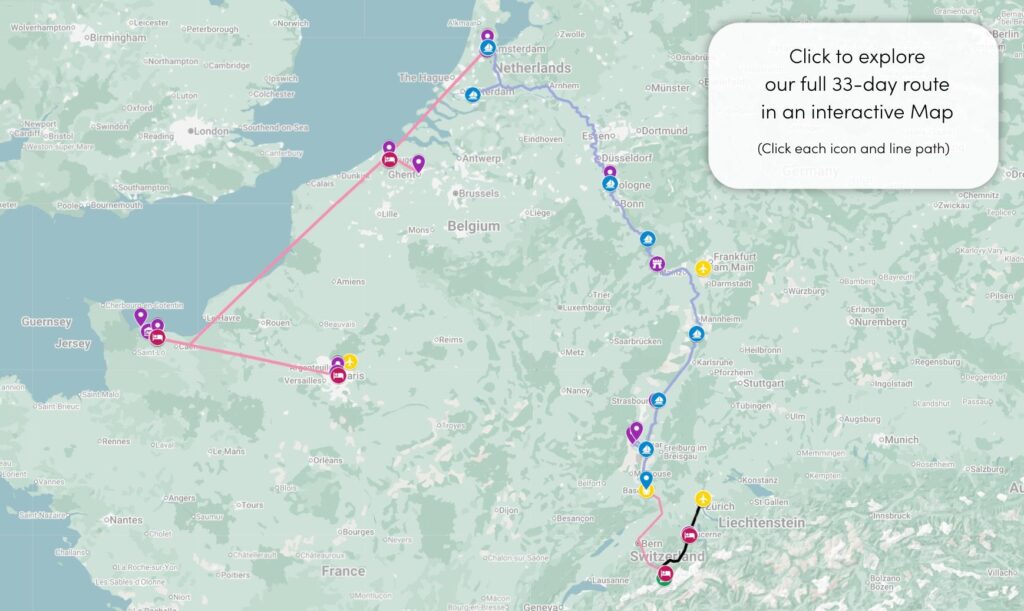
Curious how it all looked on the map?
Below is a visual summary of our full 33-day route—hotels, attractions, Viking cruise path and stops, as well as transit modes and paths—hiking, train, plane, gondola.
Click to explore the interactive version and wander through the journey pin by pin.
Links to resources mentioned in this piece: