
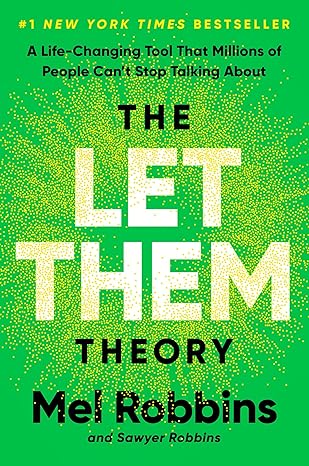
Mel Robbins’ The Let Them Theory may be one of the simplest books I’ve ever read—and also one of the most transformative. Yes, she repeats herself. Yes, the concept sounds obvious. And yet, the brilliance lies in how she distills that simplicity into something you can actually live by. I didn’t race through this book; I read it in small bursts, setting it down often and returning when I was ready. But even before finishing, I began applying it. I “let them” every day now—and the results have been tangible. My reactions have softened. My peace has expanded. It’s not theory anymore; it’s practice.
There’s a reason The Let Them Theory became a #1 New York Times bestseller, sold millions of copies worldwide, and sparked what can only be described as a movement—women are literally tattooing “Let Them” on their bodies. Robbins doesn’t present this as a research-heavy textbook, and some readers have noted the lack of detailed sourcing. Still, the book is informed by research in psychology and neuroscience and grounded in her years of personal coaching experience. What makes it powerful isn’t academic rigor—it’s accessibility. She translates big human truths into simple, repeatable language we can actually use.
It reminds me of Admiral William H. McRaven’s Make Your Bed—another #1 New York Times bestseller—another seemingly simple premise that holds real-world power when embodied.
Like a well-crafted poem, The Let Them Theory strings together familiar words in a way that shifts meaning entirely. It’s not about rediscovering something we already knew—it’s about facing a simple concept that isn’t easy to live by. We do care what others think. We want to convince, correct, or rescue.
One story stayed with me. Robbins shares how she encouraged a friend to relocate—to uproot her life and buy a home in Mel’s area—so they could be part of each other’s daily world. But once she moved, that friend naturally grew close with Mel’s other friends, and Mel found herself left out. It hurt. But instead of blaming anyone, she recognized what was real: people evolve, proximity shifts connection, and not every change is a rejection. That, she realized, is what it means to let them.
We feel hurt when friends grow distant or when life rearranges the circles we once fit inside. Robbins reminds us that the real challenge isn’t understanding the idea—it’s practicing it when it matters most—when the change feels personal.
The beauty of Robbins’ message is that it applies to all relationships—family, friends, work, even strangers. It means focusing on what you can control—yourself.
This book is about release. It’s about learning where your responsibility ends and where someone else’s begins. Robbins distills that boundary into something startlingly clear: you can’t control other people’s choices, opinions, or timing—so stop trying.
Her mantra became mine. When someone drifts from our relationship, disagrees, or doesn’t meet my expectations, I remind myself: let them. That’s the heart of Robbins’ teaching—peace isn’t won by convincing others; it’s found in acceptance. That tiny shift changed everything.
I’ve also learned what “letting them” looks like in my everyday life. It’s not easy. When someone doesn’t respond as soon as I expect, or when someone I love makes choices I don’t agree with, I remind myself to let them. It’s not easy. As a mom—and as a person who instinctively steps in during crises—I’ve had to unlearn my reflex to manage, guide, or fix. I’ve learned to be less judgmental and more accepting; that someone else’s business isn’t mine to handle; that what others think of me is beyond my control; that I don’t owe anyone an explanation for my whys and hows. I’ve learned to stay present, to listen, and to truly relish other people’s stories. By letting them be them, I get to be me—and live fully in the moment.
For years, my role was to be the caretaker—to ensure my kids and family had everything they needed. It was my honor and my privilege—the best years of my life—and I gave it my all. But turning off that instinct is one of life’s crueler realities. One day, my purpose was to build the nest so my kids could fly; the next, they did. That transition felt sudden, even when it’s exactly what I worked toward. The Let Them mantra reminds me to release the grip, to trust the flight, and to find peace in the space that follows.
It turns out letting them is really about letting me.
Key Takeaways from The Let Them Theory by Mel Robbins
-
You can’t control other people’s choices or opinions—so stop trying.
-
“Let Them” is about releasing the need to manage, fix, or explain others.
-
“Let Me” is the companion mindset—focus on your own responses and actions.
-
Your peace matters more than someone else’s approval.
-
Detachment is not indifference; it’s emotional freedom.
-
The more you “let them,” the more energy you reclaim for what truly matters.
-
Boundaries aren’t walls—they’re self-respect in practice.
-
People will show you who they are; believe them and adjust accordingly.
-
You teach others how to treat you by how you respond, not by how you argue.
-
Letting go of control allows better things to unfold naturally.
-
Change begins with awareness of your own patterns, not theirs.
-
Letting people be themselves doesn’t mean accepting poor behavior—it means not internalizing it.
-
You don’t need closure from others to move on; you can give that gift to yourself.
-
“Let Me” means taking radical responsibility for your energy and time.
-
The goal isn’t to fix relationships—it’s to find peace within them.
-
Releasing control doesn’t weaken you; it strengthens your presence.
-
The simplest truths are often the hardest to live—and the most powerful when practiced.
It started as one of the simplest books I’ve read, and it’s ending up one of the most transformative. For a book built on such a simple premise, I’m glad I found it—and I highly recommend it.
You might like…