
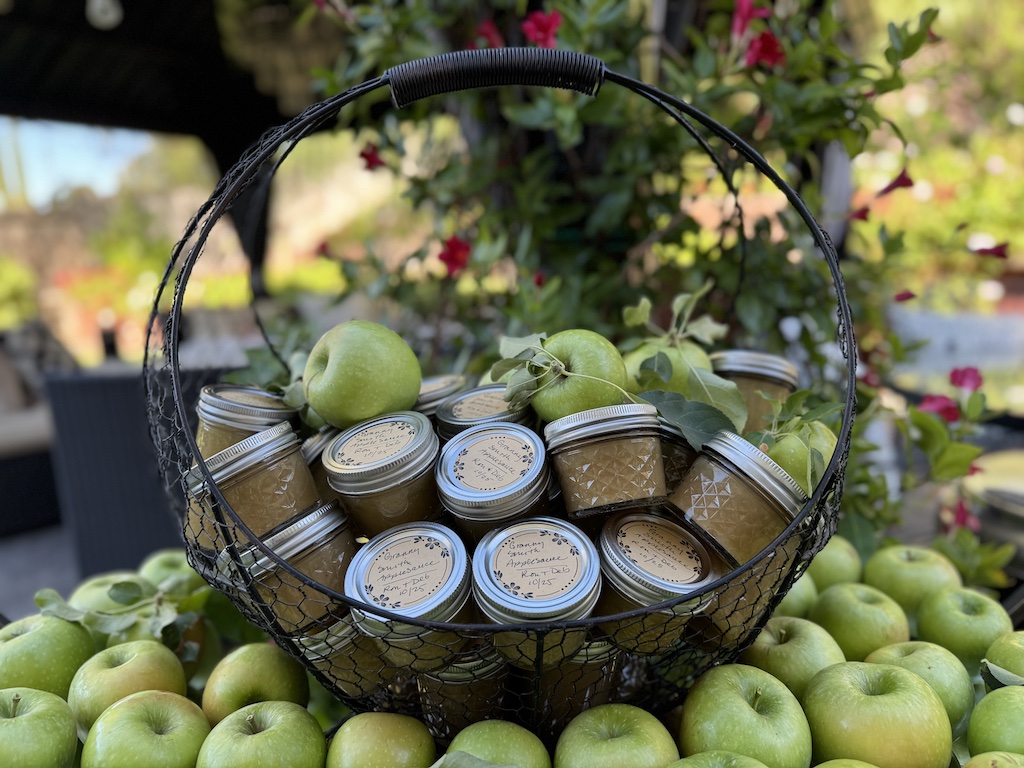
Homemade Applesauce: A Bucket List Item Completed
I’m late to the practice of canning my own food. My curiosities always push me forward to try new things—and making things and giving them away is one of my love languages.
So the fact that I’ve never canned my own food has always perplexed me.
I finally discovered why: I was afraid. What if I didn’t do it right and someone got sick? Oof—that’s a lot of responsibility.
My apple tree flourished this year—so full of fruit that the branches bent low and heavy. There was no way to ignore them, and I certainly couldn’t eat them all. It seemed so wasteful. It was as if my tree pleaded with me, “C’mon already! You’ve got this!”
I thought about gifting the apples. Then I thought about donating them to a food bank.
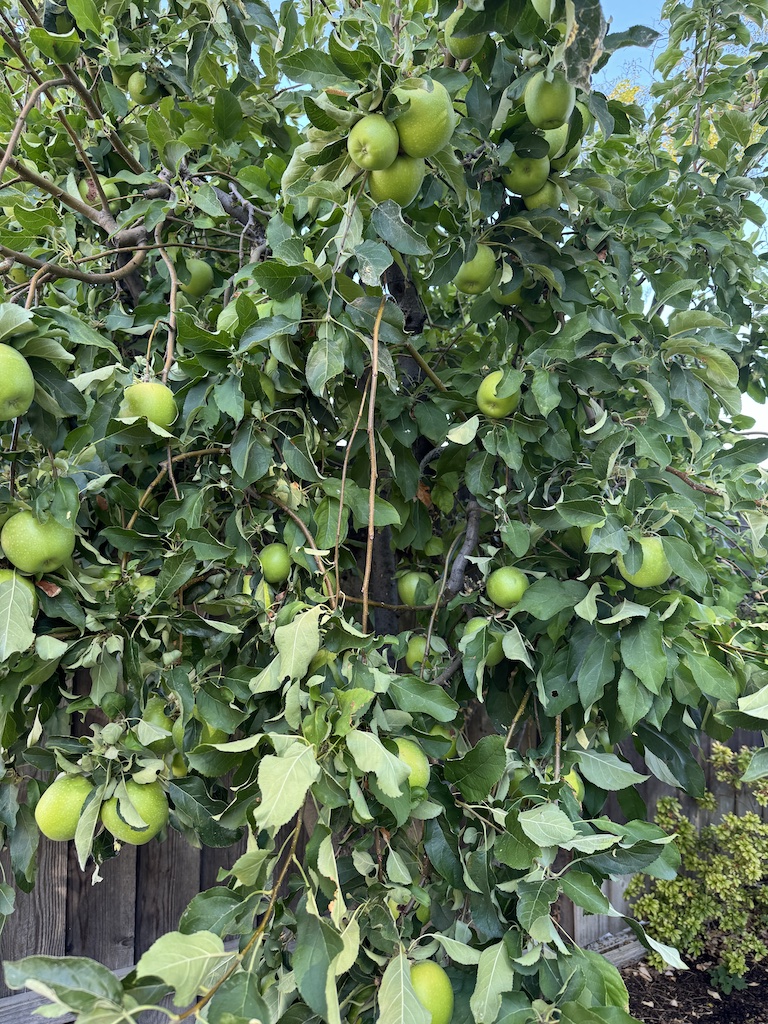
My apple tree, loaded with fruit, practically begged me to make applesauce. What you see here is just a fraction of the apples I picked. We canned four large pots of applesauce and still gave a large bag of apples away.
In the end, I accepted the challenge.
Canning my own food turned out to be deeply satisfying—and surprisingly simple. Healthy and delicious, too.
I canned 4-ounce jars because I like to have fresh applesauce on a whim, and that size is perfect for one serving. When I used to buy applesauce from the grocery store, I always found that we didn’t eat it fast enough (even with four boys) and it spoiled. I also canned 8-ounce jars for gifts.
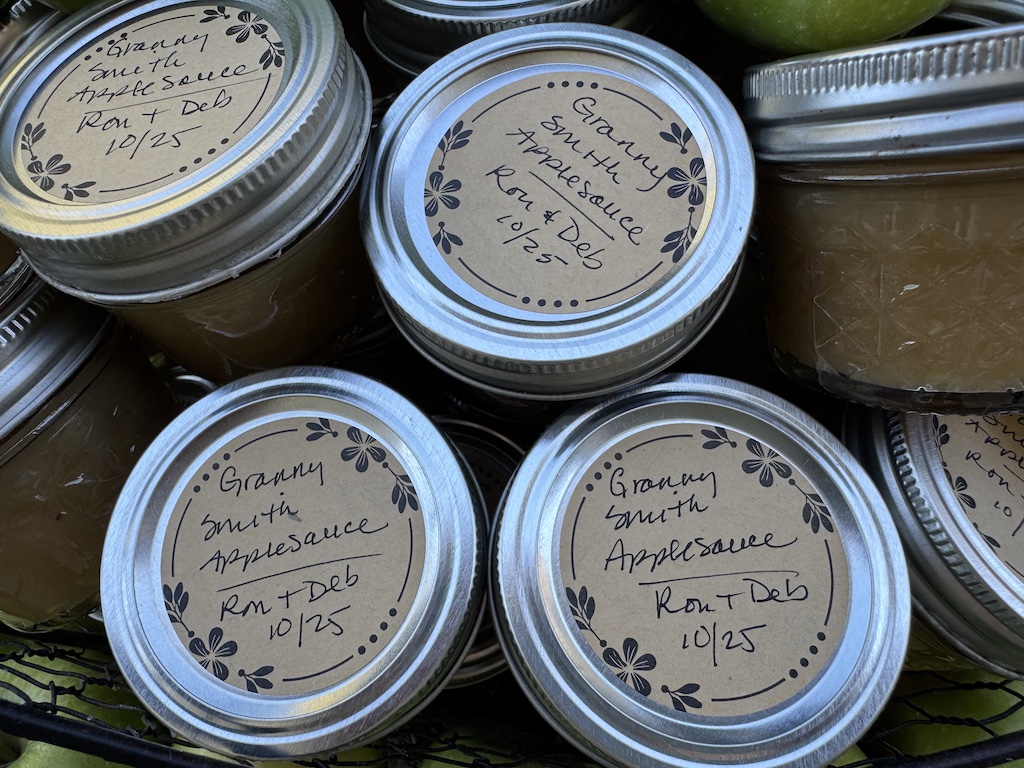
I used these 4 oz. jars, these 8 oz. jars, and these labels.
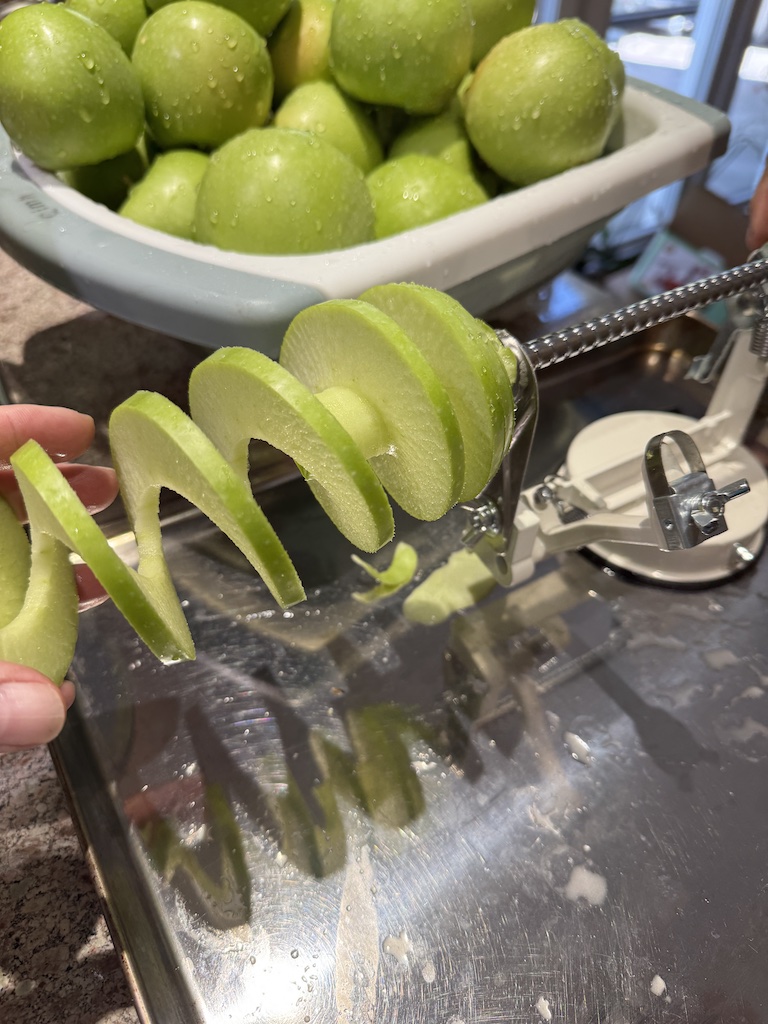
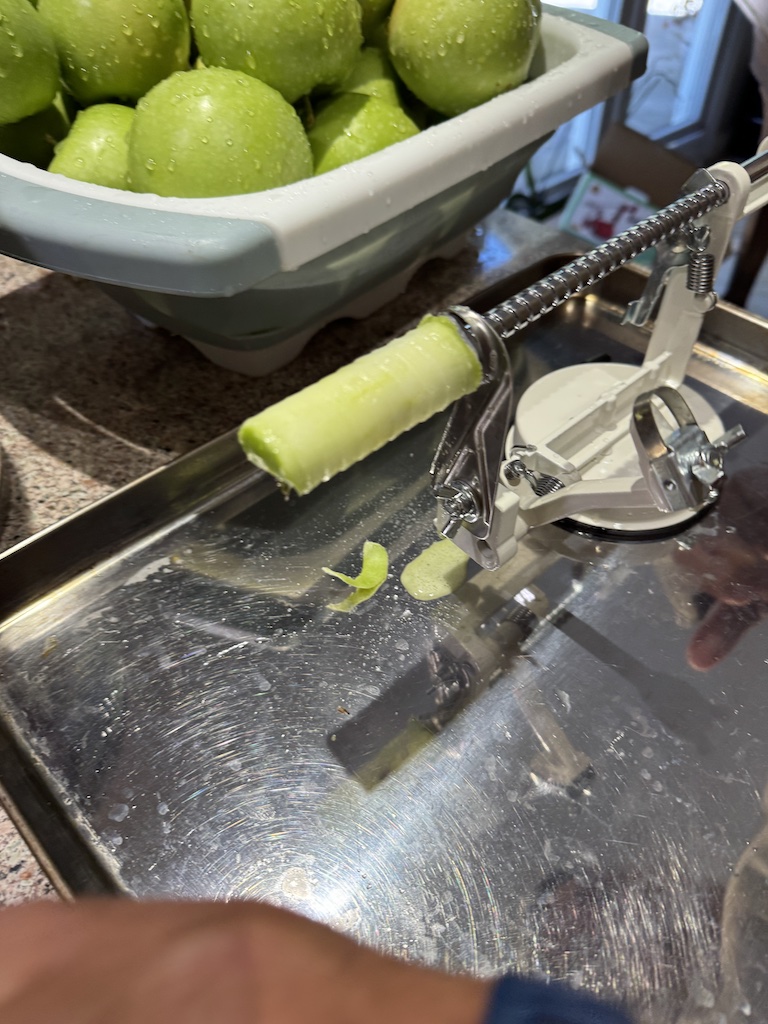
I used this Apple Peeler, Slicer, and Corer.
Click (or tap) any photo to open the gallery, see the full image, captions, and scroll through the set.
A Few Tips
Watch out for the bloops! Naturally sugary apple pulp sticks to skin and can burn when the applesauce “bloops” during cooking. I had a quarter-sized bloop of applesauce hit my arm—it created a thick scab and will probably scar. I waited too long to apply my favorite burn ointment, Scar Zone Burn Gel. Had I used it immediately, I likely would have avoided the pain, scabbing, and possible scar.
The immersion blender is a dream (but again, beware of the bloops!).
In one video, I learned a trick: keep the jars on a cookie sheet in the oven at 250°F. I removed them with tongs, set each jar on a towel on the counter, then filled it with hot applesauce. Ron placed them immediately into the hot water bath.
I watched so many YouTube videos—some were downright scary—but I’m glad I watched this one: You’ve Been Canning WRONG If You Don’t Know These Simple Safety Tips!
What I Learned
Precautions When Canning Applesauce
-
Use store-bought lemon juice instead of fresh.
The pH is more reliable and ensures your applesauce is safely acidic for canning. -
Maintain the right amount of air space in the jar.
Headspace matters. If you don’t have enough applesauce to fill the jar while leaving the proper space, refrigerate that portion and eat it within two weeks. You can’t safely can it without the correct air space. -
Avoid electric stovetops for canning.
Electric burners heat and cool unevenly, which can cause temperature fluctuations. A constant rolling boil is essential for safe processing. We used a very large pot we use for cooking crabs on a gas burner on the patio. The canning tongs and bottom rack are essential. -
Use the right canning method.
Always use a boiling-water bath canner. Applesauce is high-acid, so pressure canning isn’t necessary. Never try to shortcut by using an oven, dishwasher, or “flipping jars upside down.” Those methods aren’t safe or reliable. -
Start with clean equipment.
Sterilizing is not necessary, but wash jars, lids, and bands in hot soapy water, then rinse well. Use new lids every time to ensure a good seal. -
Use only fresh, sound apples.
Avoid bruised, moldy, or spoiled fruit. Don’t use windfall apples that have been on the ground. If apples were sprayed, wash thoroughly and peel if desired. -
Keep acidity balanced.
Most apples are naturally acidic enough for safe water-bath canning, and I chose to use Granny Smiths. Because they’re already tart, I didn’t add extra lemon juice to the applesauce itself. I did place the sliced apples in a large bowl of water with a couple of tablespoons of store-bought lemon juice—not for acidity in the final product, but to keep the apples from browning while I prepped a large batch before cooking.If you use milder or sweeter apple varieties (like Fuji or Gala), it’s wise to add 1 tablespoon of bottled lemon juice per quart of sauce to be sure the acidity remains high enough for safe canning. When in doubt, a little extra lemon juice won’t hurt—it just adds brightness.
-
Hot-pack the sauce.
Always reheat applesauce to boiling before ladling into jars. Fill jars to within ½ inch of the top (headspace). Wipe rims clean before sealing. -
Process fully.
Process any size jar for 20 minutes in a boiling-water bath (adjust for altitude). Don’t start timing until the water returns to a full boil. Then let cool for 11 minutes before removing from the pot. -
Check seals after cooling.
Let jars cool undisturbed for 12–24 hours. The lid should be concave and not flex when pressed. Remove the bands, wipe the jars, and label with the date. -
Store properly.
Store sealed jars in a cool, dark place. If any jar didn’t seal, refrigerate and use within a week. For best quality, use within 12 months. It’s best to store without the outer ring. Why? Removing the ring helps you spot a broken seal more easily (because a lid that bulges or becomes unsealed won’t be held in place by the ring), and it prevents moisture-build-up and rust under the ring that could compromise the lid or mask spoilage. -
Avoid adding unsafe ingredients.
Don’t add dairy, fats, or thickeners (like flour, cornstarch, or butter) before canning—they can lower acidity and cause spoilage. If you want to flavor your applesauce (cinnamon, nutmeg, etc.), spices are fine. I used cinnamon in some of my jars and one cup of sugar per large stock pot of sliced apples. Adjust to your taste. -
Keep the jars hot while filling, then move them immediately into the water bath.
To prevent thermal shock (cracks or breakage), fill hot jars with hot applesauce and keep temperatures consistent. You can do this in one of two ways:
• Simmering-water method: Keep clean jars submerged in simmering water until you’re ready to fill them.
• Oven method (what I did): Place clean jars on a cookie sheet in a 250°F oven while the applesauce cooks. When ready, remove a jar with tongs, set it on a towel, fill it immediately, and cap it.After sealing, place each jar directly into the boiling-water bath. Pre-sterilizing isn’t required for high-acid foods processed for more than 10 minutes, but keeping the jars hot prevents breakage and ensures a reliable seal.
Bucket List Item: Completed.
There’s something deeply grounding about it—preserving what you grew, knowing exactly what’s inside, and sharing it with others. It’s delicious to eat and really special to gift.
I know people can food all the time—and so many say how easy it is—but there’s tremendous responsibility in it. You’re sealing and preserving something meant to be eaten later, and that deserves care and respect.
Ron and I have always caught our own seafood, packed and frozen it, and given it away. He gets an elk nearly every year as well, which we have professionally processed and packaged. We’re not strangers to harvesting and preserving what we eat, so canning should fit naturally into our rhythm of living.
I hope to grow more comfortable with canning and plan to do much more in the future. We live in the heart of California’s San Joaquin agricultural region, surrounded by farm stands, orchards, and weekly farmers markets overflowing with local produce. It feels like the perfect place to keep learning—and keep canning.
Wishing you bubbling pots, no bloops, and happy canning!
❤︎
If you liked this post, you might enjoy this one about apples, too.
2 comments
This is so cool! Love that you did this.
The apple spiralizer/corer is so nostalgic for me! It reminds me of when I was younger and we would drive to the mountains of NC in the fall to go apple picking.
Sounds beautiful! What did you do with all of the apples you picked?