

Lucerne is the most beautiful town in Switzerland.
– Johann Wolfgang von Goethe
This post is part of my 33 Days in Europe series. Visit the hub page to follow along, see the full itinerary, and sign up for email updates.
On our last day in Lucerne, we made sure to see the Bourbaki Panorama. It’s a blend of art and history, presented in a way that made me feel like I was inside one of those View-Masters scenes from my childhood, those binocular-like lenses showing slides of 3D images. Kinda cool.
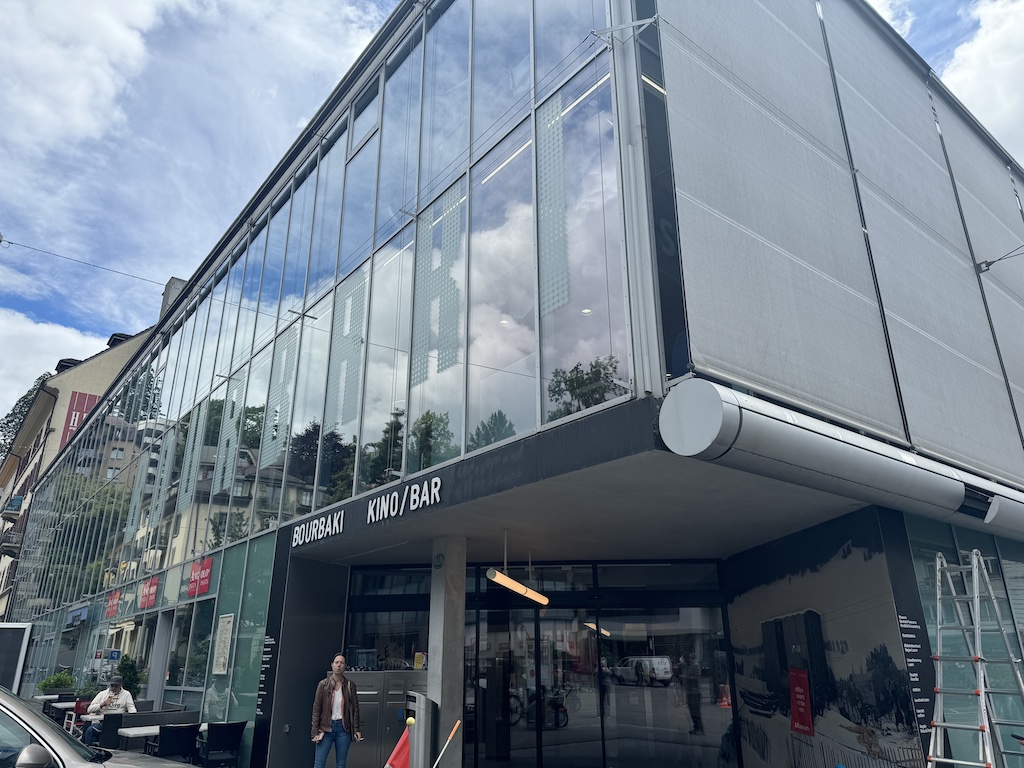
I found the juxtaposition of the sleek, modern building housing such an old, immersive art installation charmingly quirky.
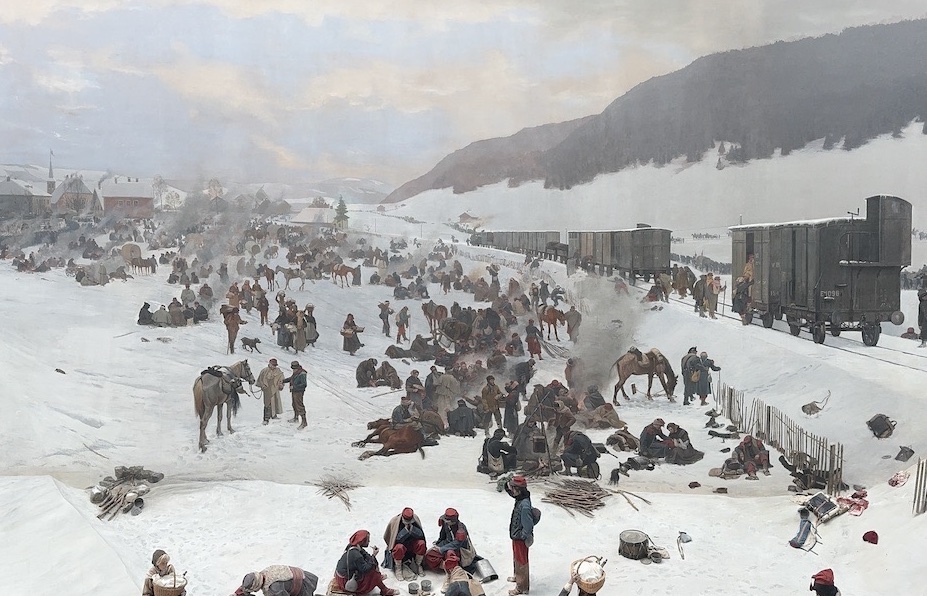
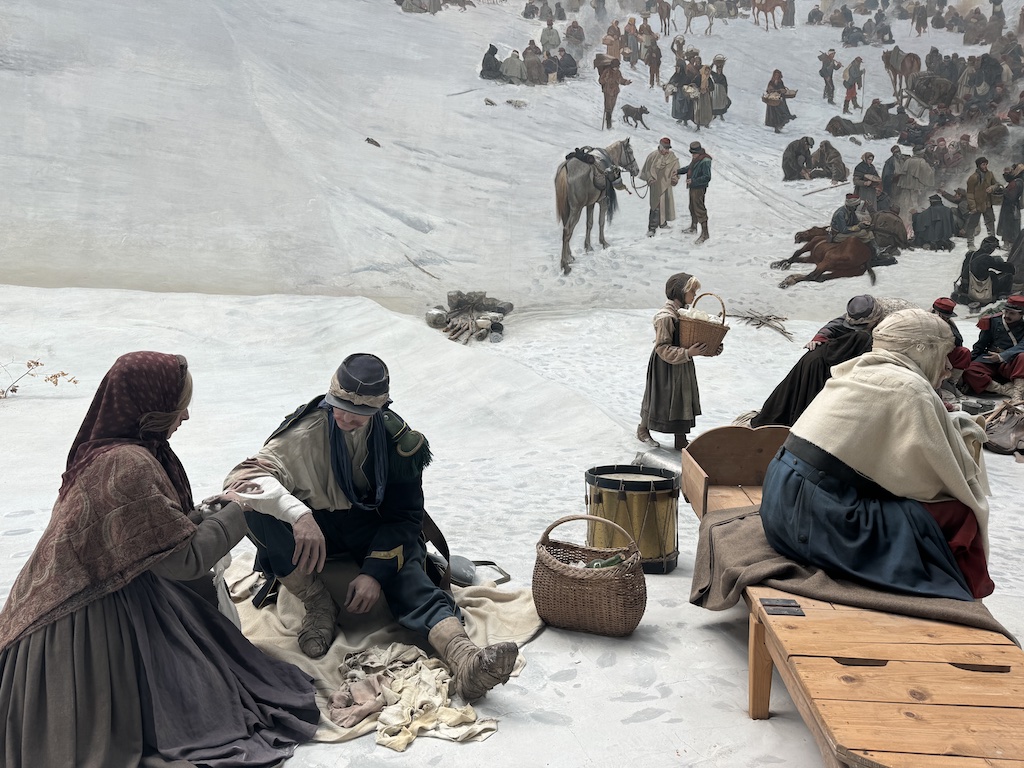
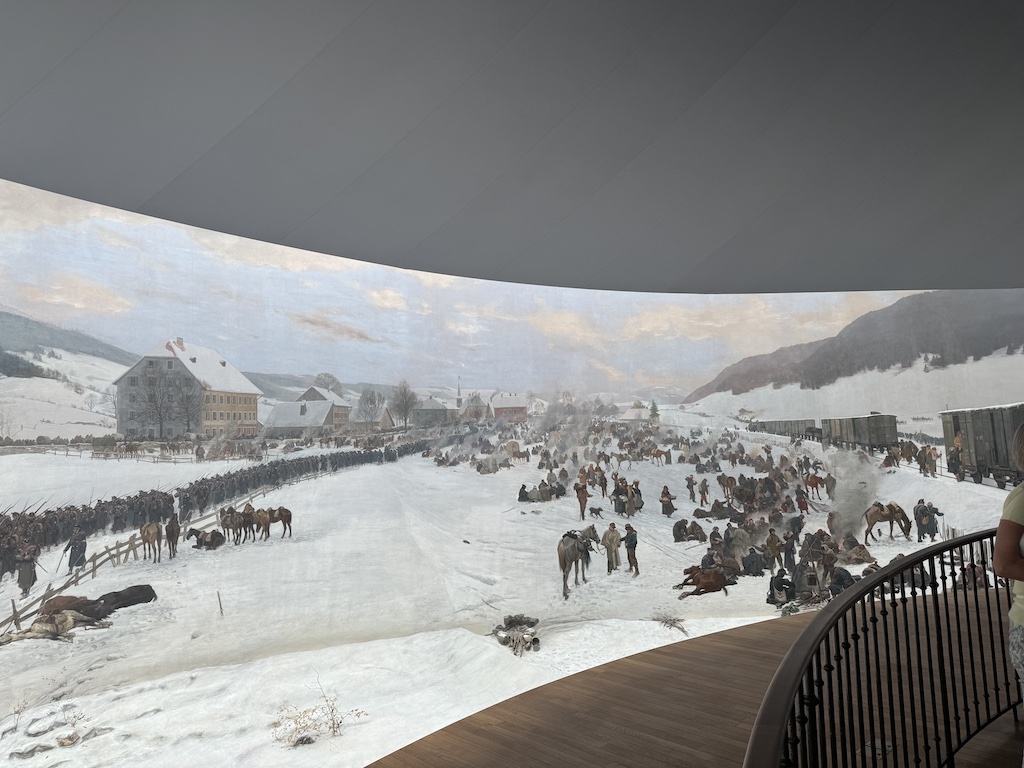
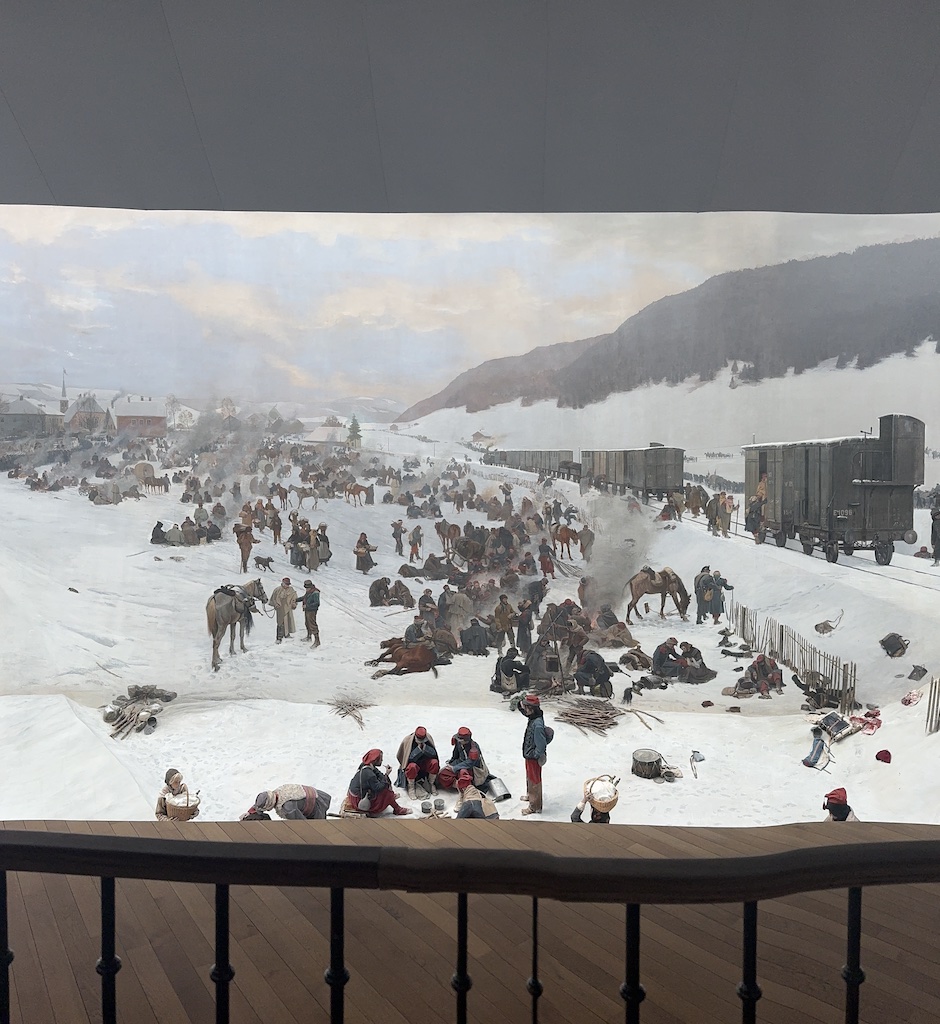
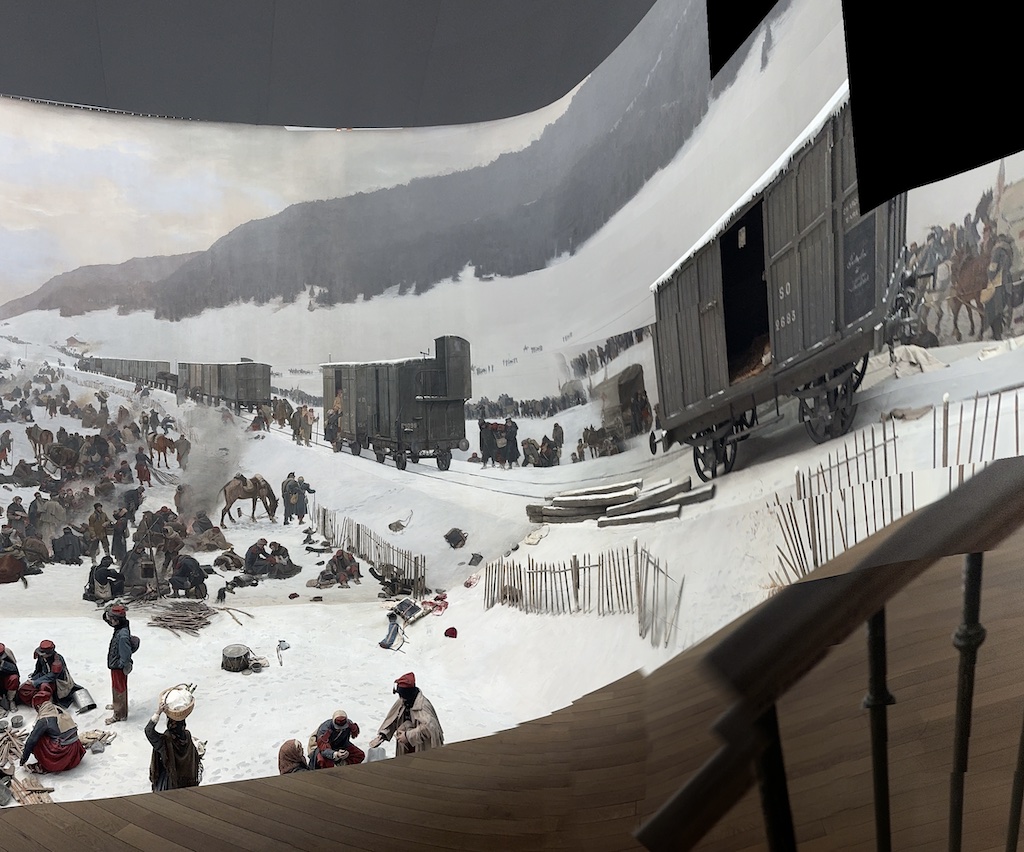
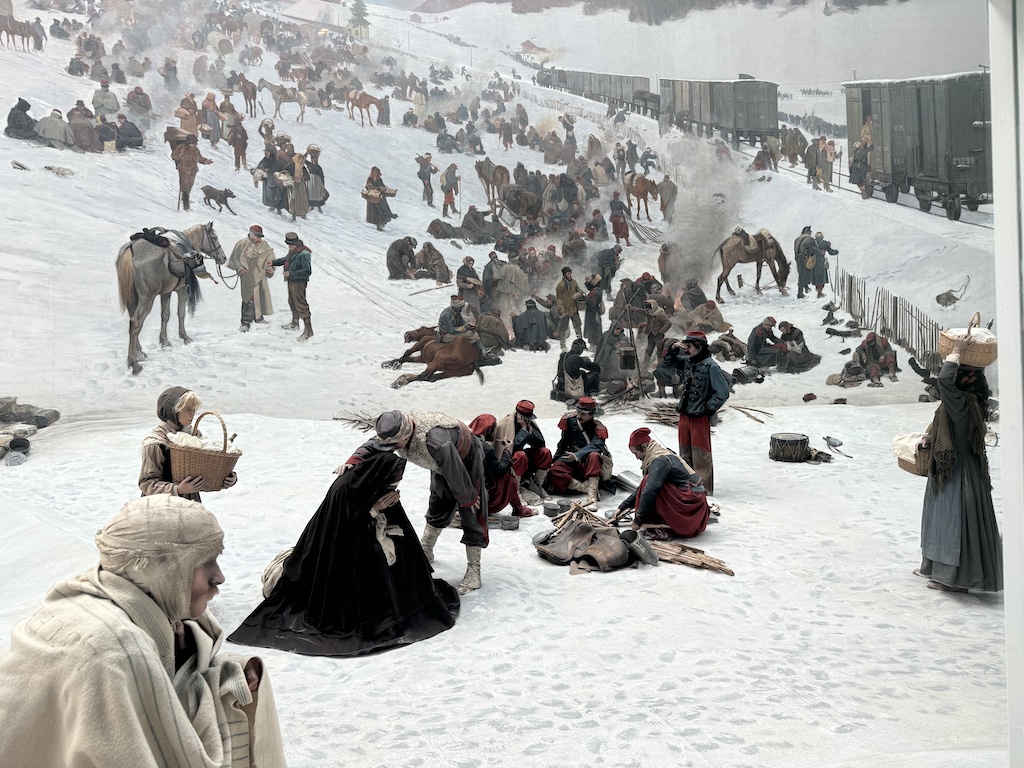
I’ve tried to capture the beauty of the piece, but photos just don’t do it justice. The installment is in a huge rotunda. The visitor’s platform is raised, accessible via steps (and somewhere an elevator) and the entire panoramic canvas—paired with 3D elements in the foreground—creates a surreal space. Surrounded by “snow” with life-sized props of women and children helping wounded men, along with the hush of the rotunda felt eerily real. I practically shivered from the cold, vast winter scene. It was as if, the best one can manage from a distance of more than 150 years, I was there. The still, silent room evoked the same dead-quiet cold space I’ve experienced in Tahoe when the falling snow silences the world. Ron and I lingered a while to take it all in.
Can you tell from my pictures what’s painted and what’s real? One of the railway cars is actually real. Mannequins crouch near small fires, horse prints appear freshly pressed into snow. The line between art and reality blurs.
The installment stands remarkably clean and cared for—so much so that I searched for any sign of aging (proof, I suppose, of its purported age, since it seemed so fresh) and found not a dust ball nor even an expected layer of dust. I found it curious that this thought crossed my mind, even though I’d never question the age or upkeep of other treasures in museums. I came to admire the care and preservation of it.
Historical Background: A Moment of Refuge
The installment portrays an important event. In February 1871, during the final days of the Franco-Prussian War, more than 87,000 French soldiers from the Army of the East—led by General Bourbaki—retreated into neutral Switzerland after being surrounded near the Jura Mountains. The Swiss agreed to disarm and shelter the troops in what became one of the earliest large-scale humanitarian efforts in modern European history.
Across 190 towns and villages, Swiss citizens stepped up to help. Women came out of their homes to offer food, care for the sick and wounded, and open their doors to the soldiers. Farmers, doctors, and townspeople worked side by side to tend to thousands of men—exhausted, frostbitten, and far from home.
Art That Bears Witness
The Bourbaki Panorama was painted in 1881 by Swiss artist Edouard Castres, who had witnessed the event firsthand as a young Red Cross volunteer. A decade later, he returned to the story with a team of ten artists, creating a monumental circular painting—367 feet long and 33 feet high—to honor what had happened.
To heighten the realism, they added a 3D foreground: sculpted snowbanks, a real railway car, props, campfires, and mannequins wrapped in wool cloaks. The result is a layered, immersive experience that blurs the line between art and witness.
Though painted by many hands, the artists’ styles are so skillfully blended that their individual brushwork nearly disappears into the larger whole. I tried to spot where one painter took over from another. I couldn’t.
Standing here helped me understand not only this moment in history, but also what it might have been like to be there. To stand in Switzerland’s deep snow, witnessing these men arrive—injured, disoriented, and unsure of what came next.
Art can be profoundly thought-worthy—not only for its beauty, not only for the artist’s unique talent and perspective, but for the history and stories it preserves for future generations. Without such powerful presentations, we would remain unaware of past traumas—but also unaware of the humanity that emerges in such harsh times.
The entire installation is perfectly preserved. I can’t imagine a more fitting way to learn about an historical event.
Reading about war satisfies the mind, but standing in a scene satiates the soul.

French soldiers in uniform receiving food and medical care from Swiss civilians in a 19th-century war refuge scene. A panoramic view.
Below, tap a picture to view them all full size. These images are best experienced in gallery view, where you can scroll through.
Here’s a quick, unrefined video. There is no intended narration. Unfortunately, a tour guide can be heard talking in the background, but I’m including it anyway. It’s the best way to feel the scope and rhythm of the scene—the full sweep of the circle. Note that the mannequins are life-sized, and we are standing in a rotunda above the scene.
Glacier Gardens: Time, Stone, and a Swirl of Water
Next, we had lunch and then visited the Glacier Garden—a fascinating glimpse into the power of glaciers and the constantly shifting landscape of Switzerland.
History of the Glacier Garden
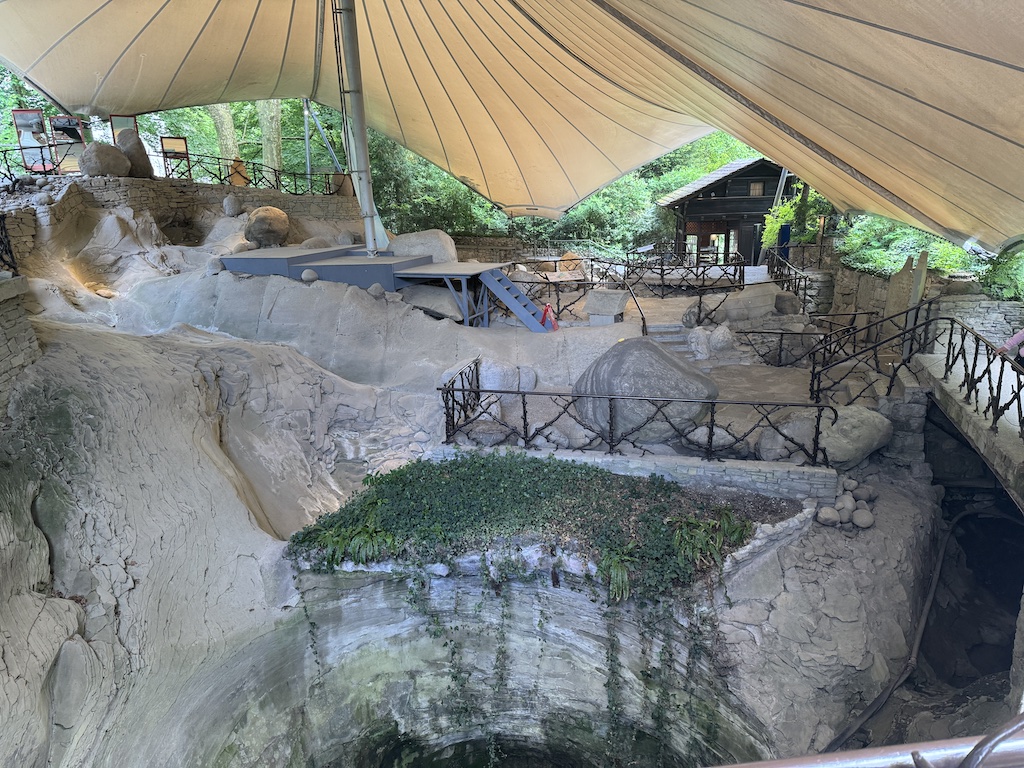
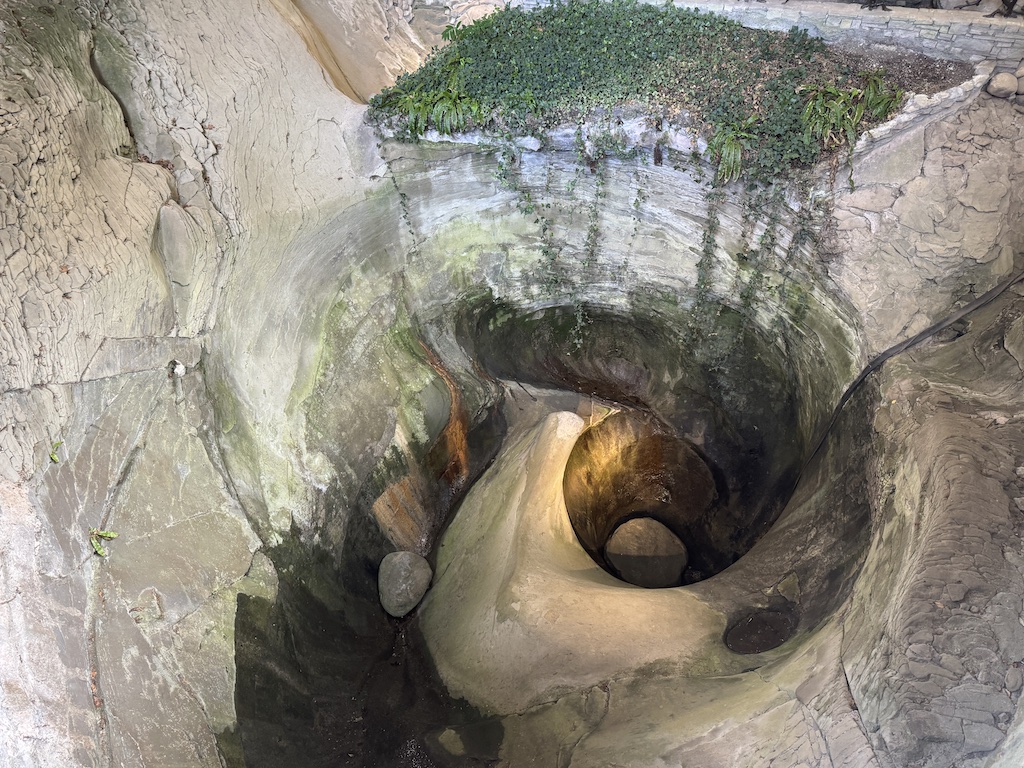
In 1872, a Lucerne man named Josef Wilhelm Amrein-Troller was digging a wine cellar when he uncovered a set of strange, smooth holes in the rock. They turned out to be these glacial potholes, carved around 20,000 years ago by glacial meltwater spinning with grit—acting like a natural drill.
The powerful water grinding stone in a spiral rhythm must have been both violent and beautiful to carve these potholes within just a few years.
Tap to view full size. These images are best experienced in gallery view, where you can scroll through.
Fossils Beneath Lucerne
We also saw fossils embedded in the sandstone—oysters, mussels, palm leaves, even bird tracks—from a time when this part of Switzerland was a subtropical seashore, about 20 million years ago.
Yes—the Alps were once lined with palm trees, making it a truly tropical location!
The museum holds ripple marks from ancient waves, a fossil slab filled with shellfish and snails, and erratic boulders dragged here by glaciers—still holding fossil shells inside.
Nature left breadcrumbs, tracing a path to a vanished world.
Inside the Felsenwelt (German for Rock World), we stepped into a dark, immersive tunnel. In one chamber, water swirled in a stone basin—a working model of how glacial potholes are formed.
Then we saw the exact date and time—our date and time—projected on the wall, down to the millisecond. Beneath it, the floor read:
The present is the centre of time… that infinitely short moment between the past and the future that can never be captured or grasped.
Knowing our time on Earth is brief presses down harder on us as we age, but being in that dark cave—with water swirling and raging so loudly I could only hear myself—and watching that clock melt away time, forced me to truly recognize that my time here is just a blip, and even as we’re conscious of a moment, it’s already gone.
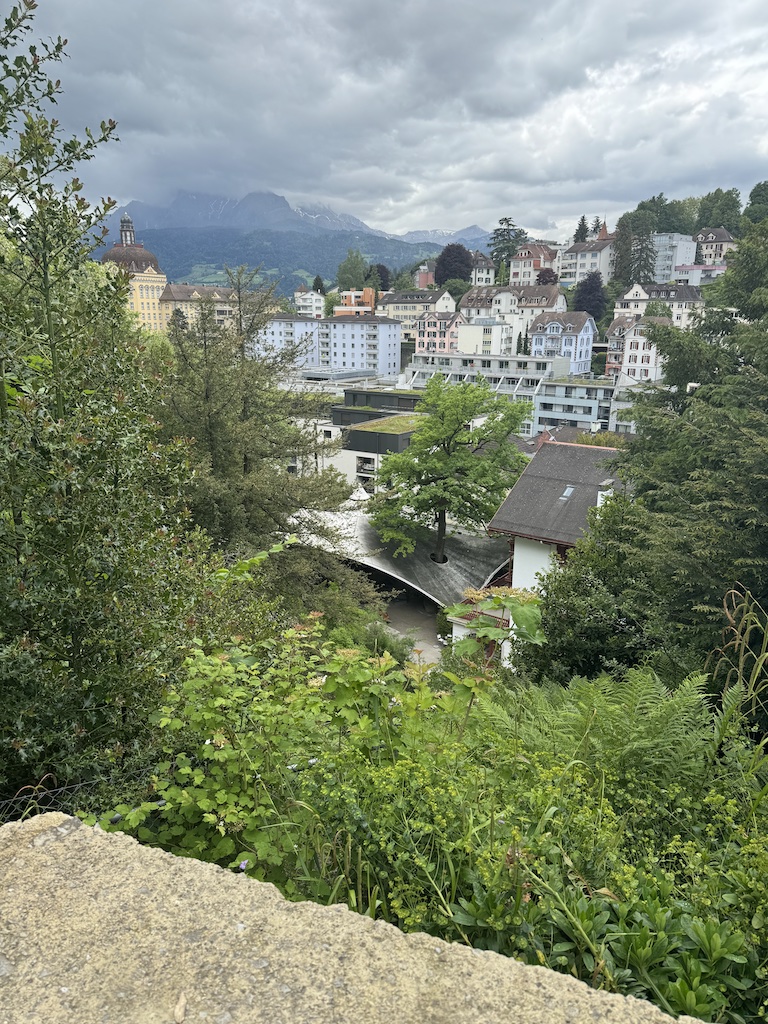
We climbed staircases cut into stone, passed ancient ripple marks and fossil palms, and eventually emerged outside on a hillside, feeling farther and more removed from the city below than we actually were.
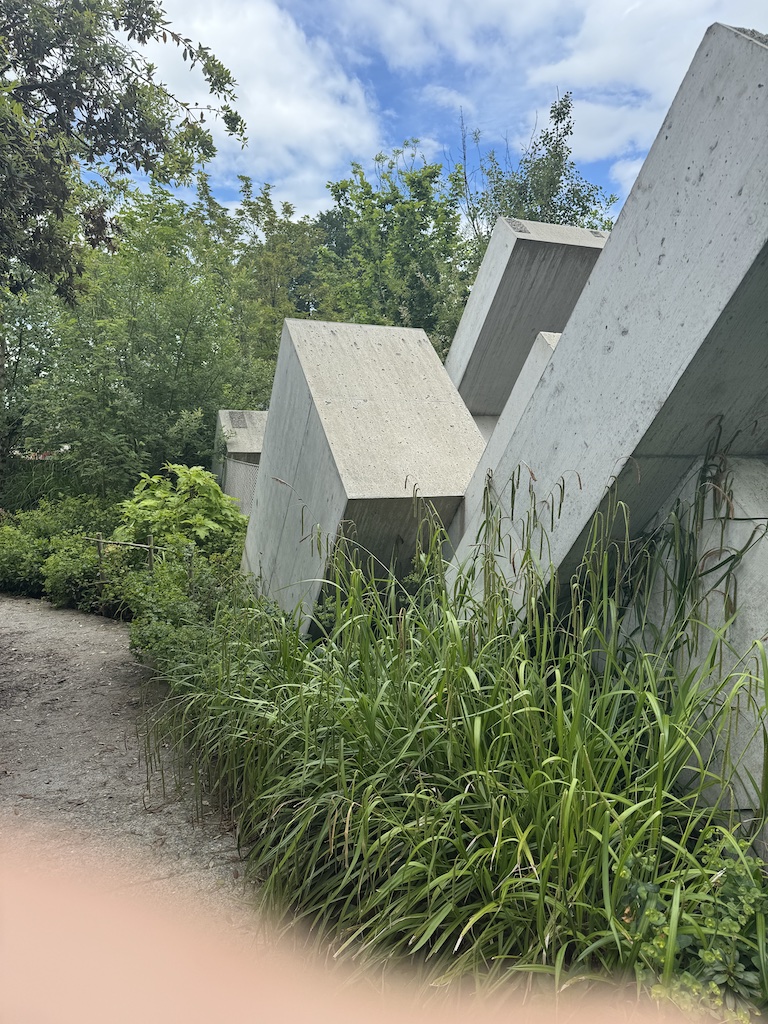
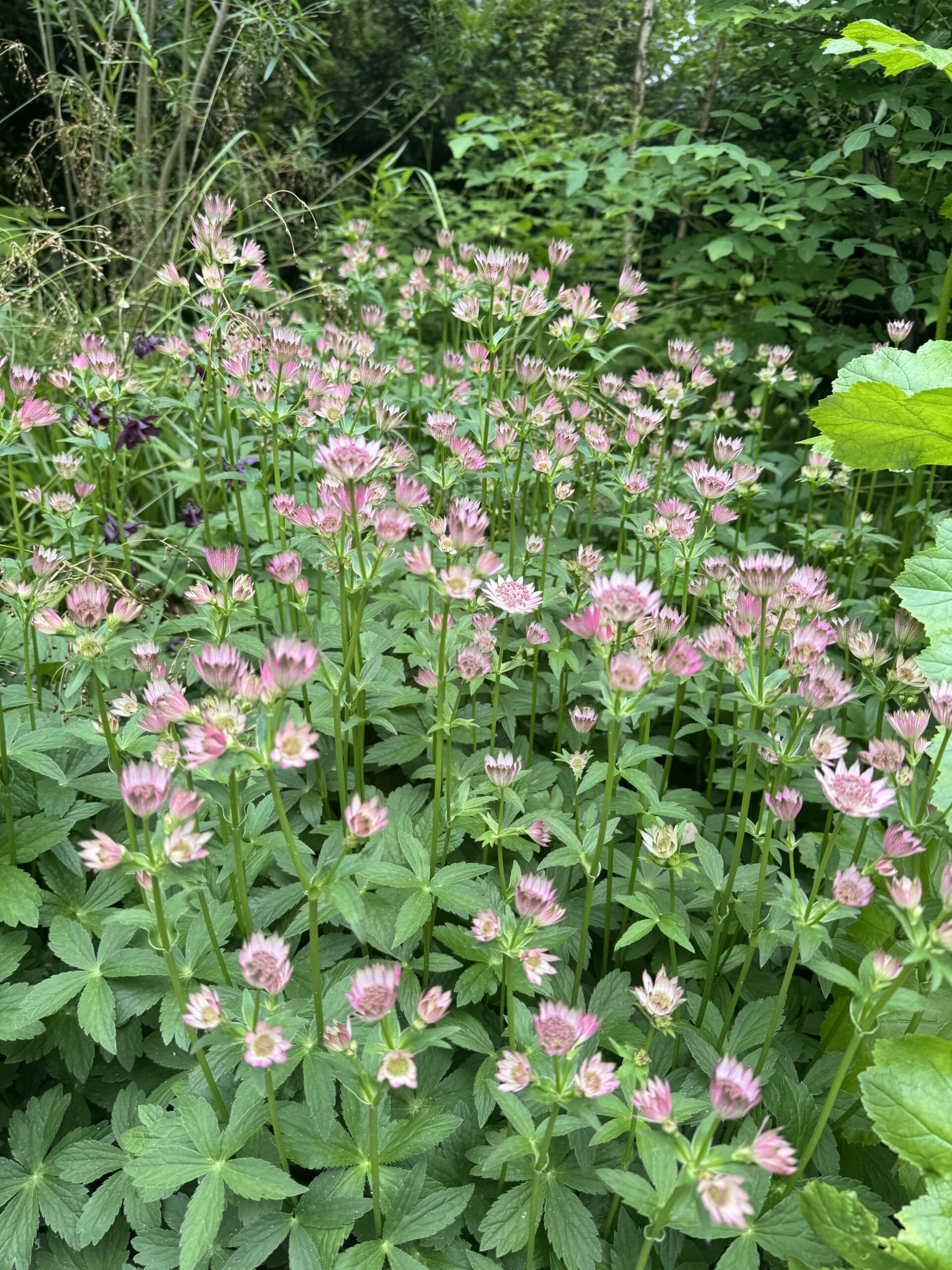
I always think in movies. Emerging from the cold dark cave through an angular cement portal and into the sunny, lush hillside with wildflowers and sweeping views made me think of one of those ’70s futuristic dystopian movies where the hero emerges into a new world, having survived some sort of cataclysmic ordeal and now reached hope: utopia.
Below, tap a picture to view them all full size. These images are best experienced in gallery view, where you can scroll through.
Wirtshaus Krienbrüggli Restaurant
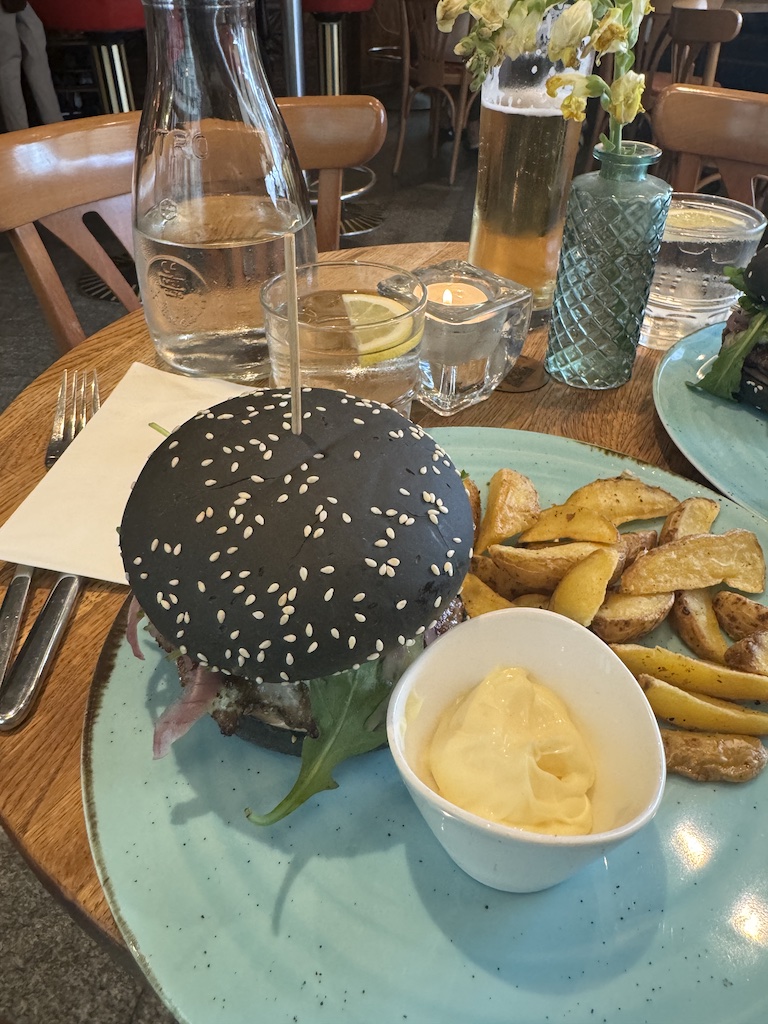
After so much history and our minds bulging with facts, we made our way back to our favorite hangout—the Wirtshaus Krienbrüggli restaurant.
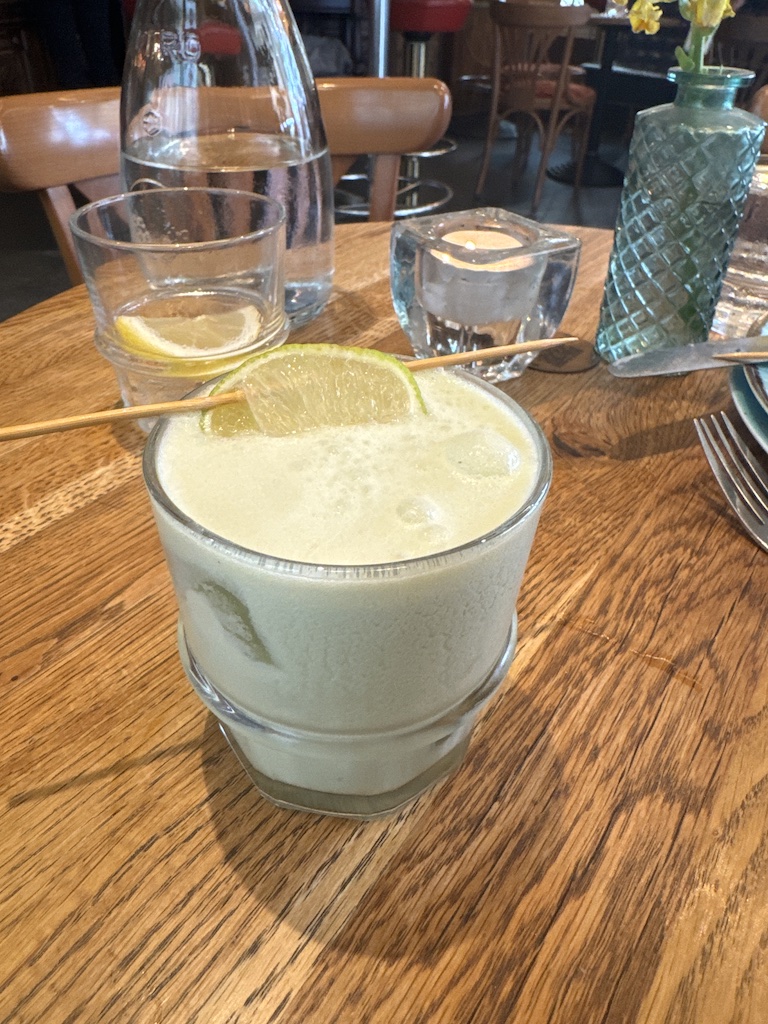
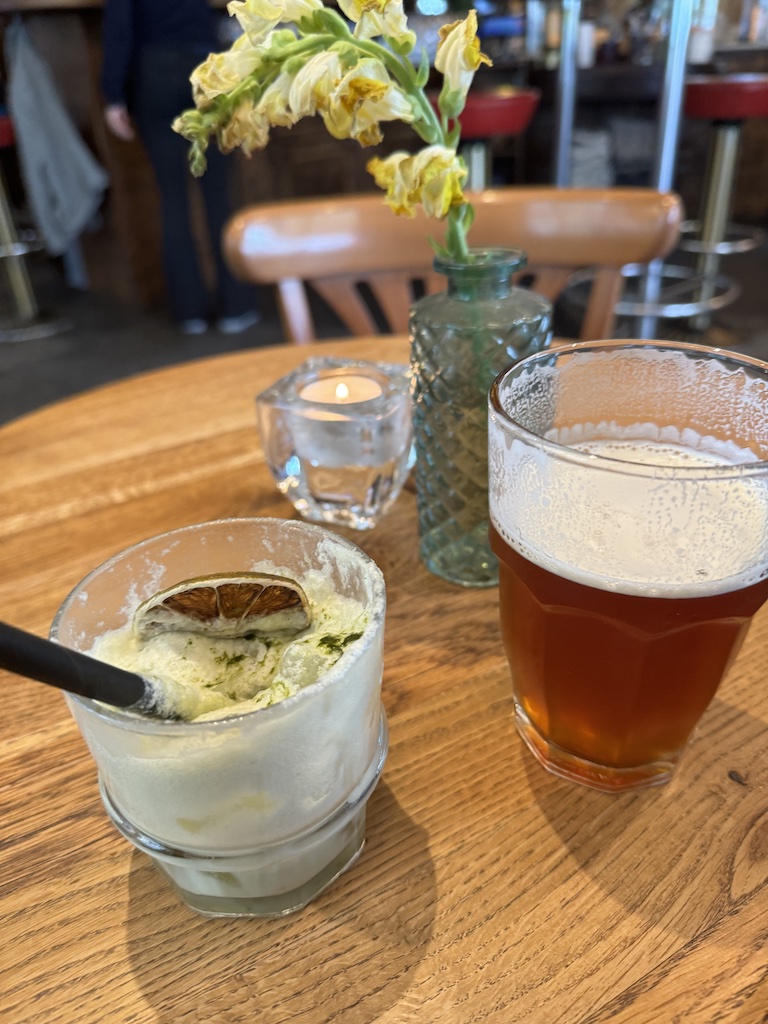
I kept dreaming of that spicy matcha drink. This time we dined on burgers. Ron had a beer. We absolutely loved this place. Check out my previous post to learn more about the restaurant and the drink details.
Tap to view full size. These images are best experienced in gallery view, where you can scroll through.
Street Musician
Along the way, we happened upon a street musician playing an instrument I had never seen or heard before. So beautiful and mesmerizing, I vowed to find out what it was and get one. Turns out, it’s a hand pan.
Bucket List item noted!
Turn up the volume for the best experience.
Hofkirche St. Leodegar
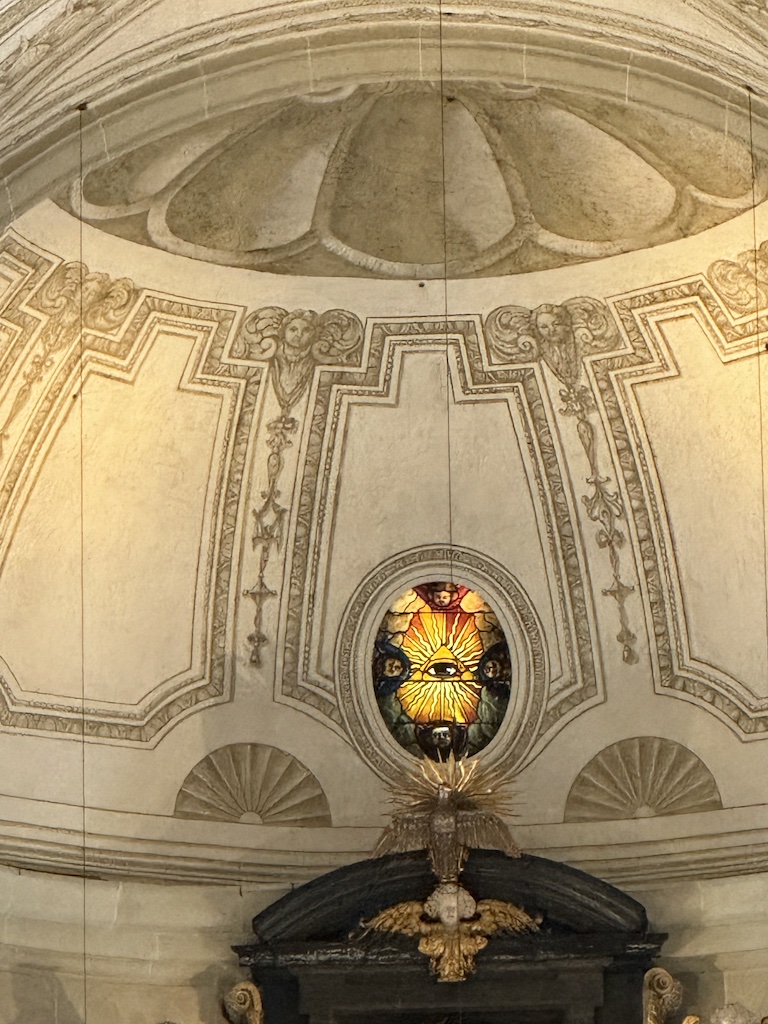
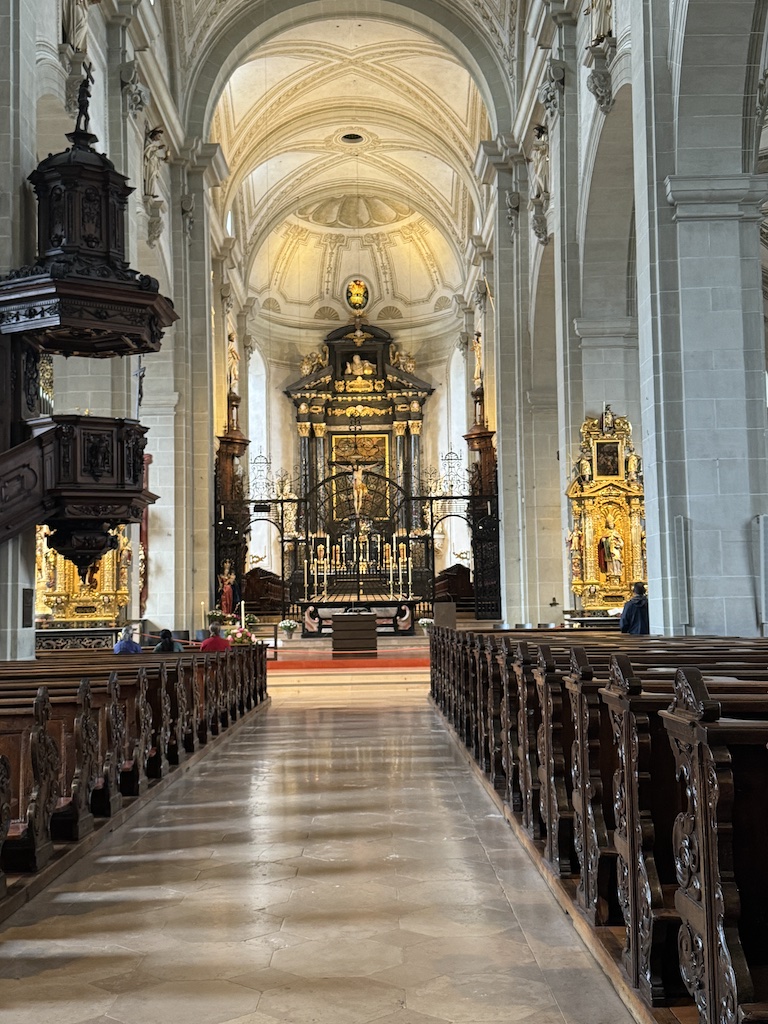
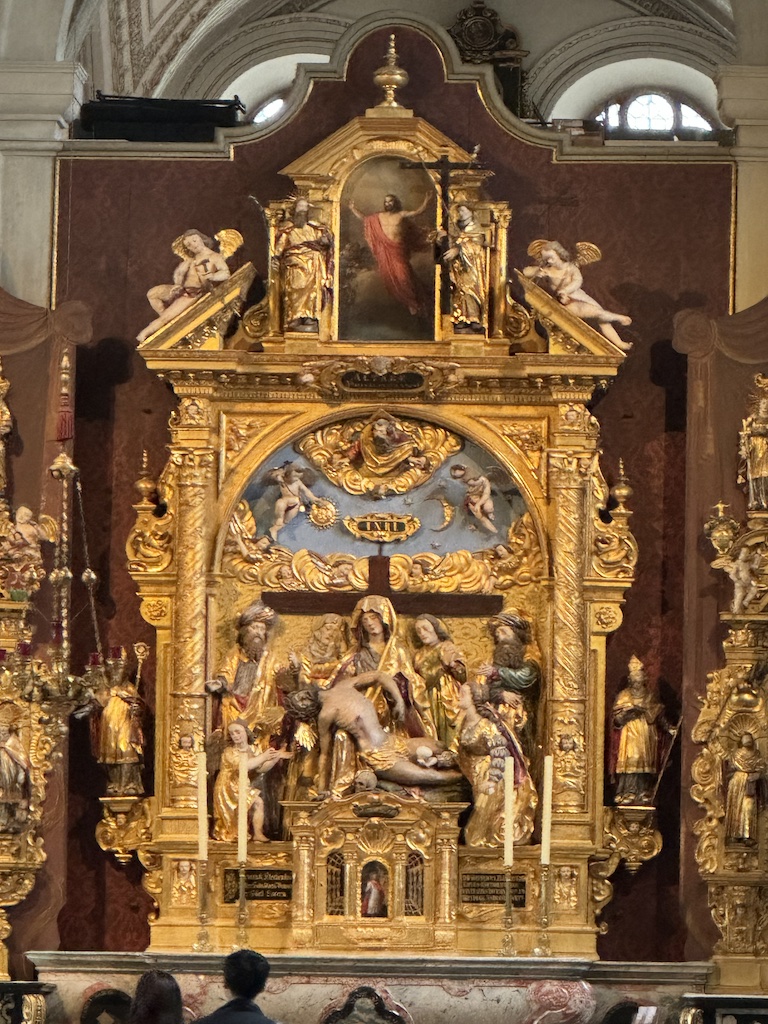
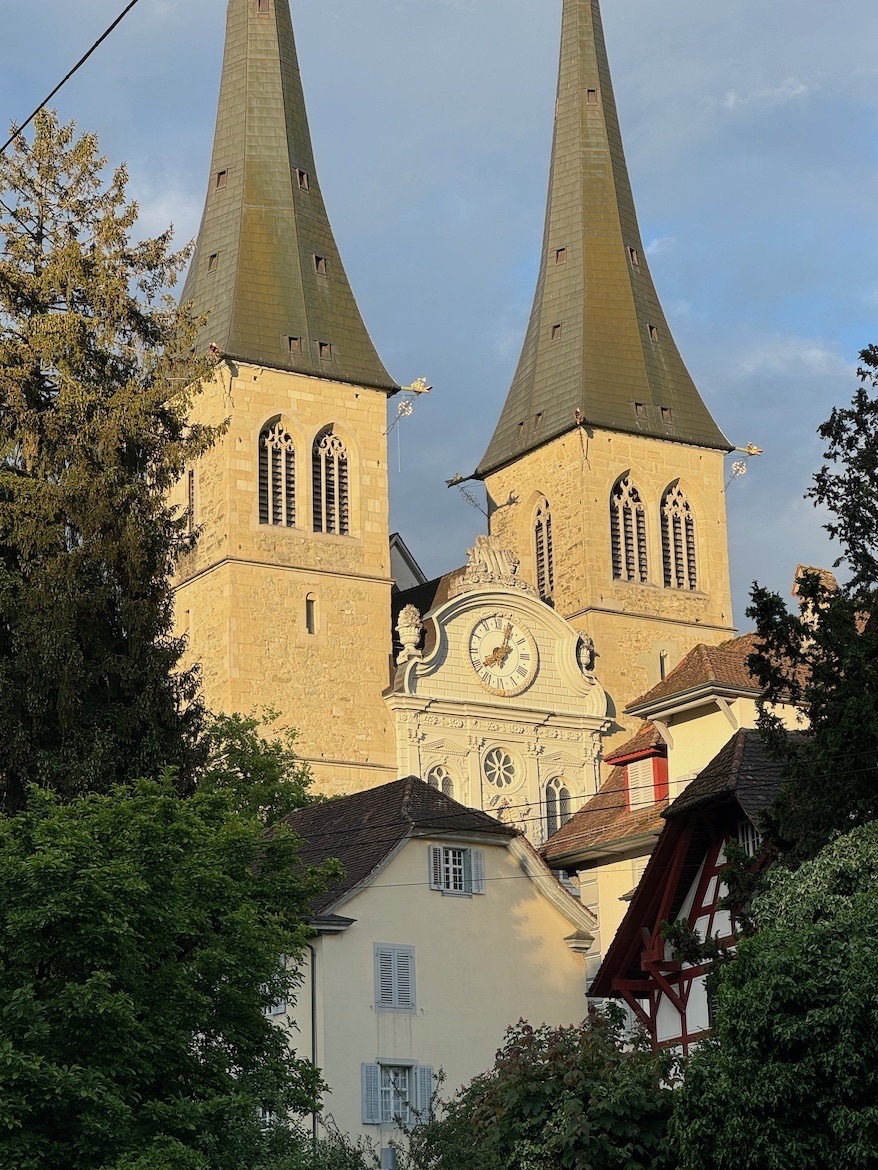
Headed back to our hotel, we stopped into the Church of St. Leodegar (Hofkirche), Lucerne’s grand Renaissance church with its gold altars and heavy carved wood.
Whenever I walk through ancient churches, I think about how many prayers must have been whispered here. Centuries of them. The air always feels thick with that history. And I always wonder how many of those prayers were answered.
Below, tap a picture to view them all full size. These images are best experienced in gallery view, where you can scroll through.
Sweet Melodies from the Hofkirche
Once at the Hotel, we collapsed in bed, our minds and hearts filled with another perfect day in Lucerne.
When the Hofkirche church bells rang, I grabbed my phone to capture the sound that so signifies being in Europe to me. This is perhaps a silly video to share since it focuses—ahem— on the floor and then the covers. I rushed to capture the sound while in bed with nary a notice. Life isn’t always about grand views. When I watch this—hear this, now—it takes me right back to Switzerland, letting me relive the whole glorious day.
I can’t think of a more fitting farewell on our last night in Lucerne. The bells welcomed us and now the bells bid us farewell.
How utterly spectacular.
It’s too beautiful not to share.
Turn up the volume for the best experience.
Next up: Day 6 – Train to the Valley: Lucerne to the Alps
Gear I Recommend
See all my travel gear and essentials here: Things I Love & Recommend
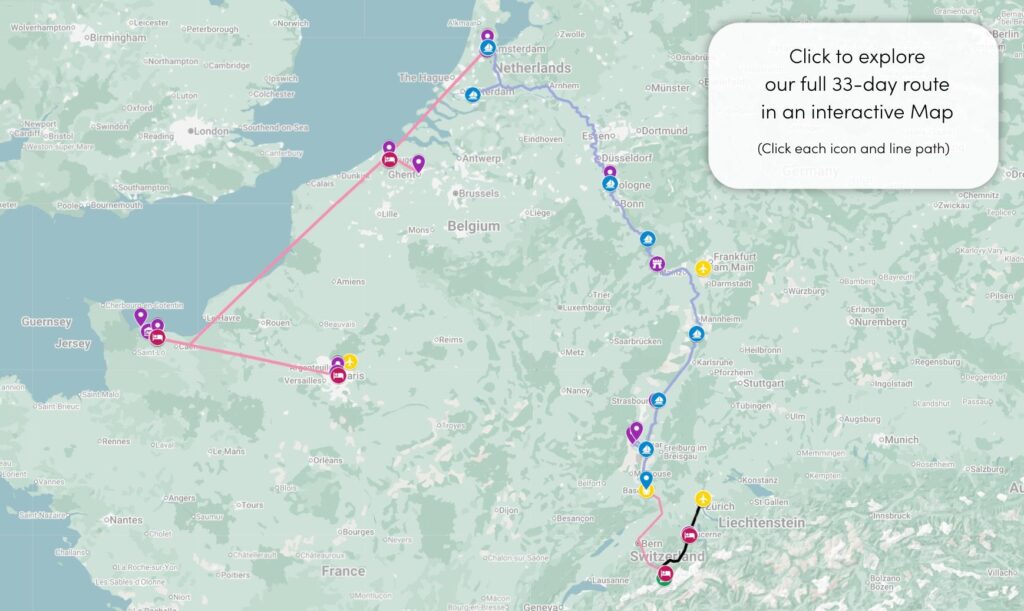
Detailed Map of the Entire Journey
Below is a visual summary of our full 33-day route—hotels, attractions, Viking cruise path and stops, as well as transit modes and paths—hiking, train, plane, gondola.
Click to explore the interactive version and wander through the journey pin by pin.
4 comments
I have the urge to comment “so beautiful!” on all of your travel posts 😉
And we are just getting started! I can’t wait to share so much. Next up…the Alps. Wait until we stand in the clouds. IN the clouds! Thank you for reaching out. 🌷
What a spectacular journey, thank you for bringing us along!
My pleasure. Thank you for visiting and sharing. 🌻